Analyzing Competitors
Systematically compare your AI visibility with that of your competitors.
Why Analyze Competitors?
Your brand’s AI visibility does not exist in a vacuum. Your Share of Voice shows your share of all detected brand mentions; the relative view additionally compares you specifically against your marked competitors. Without competitor analysis, you lack the context to properly assess your own position.
Competitor Benchmarking
ucited.ai offers you several views for competitive comparison:
SOV Timeseries
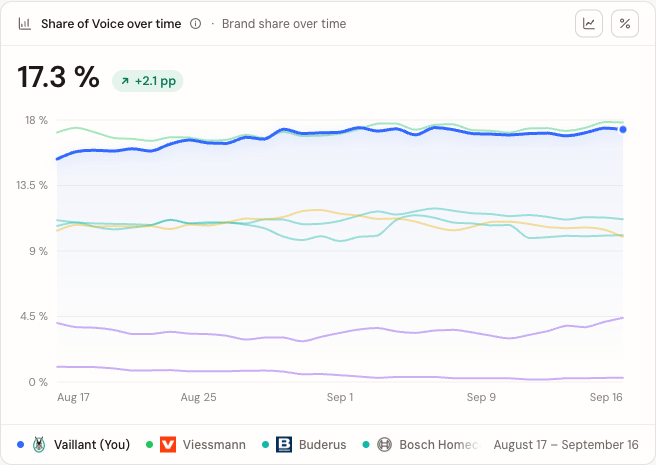
The Share of Voice timeseries on the dashboard shows you the progression of your visibility compared to all configured competitors. At a glance, you can see:
- Who is leading at which points in time?
- Are there trend changes or sudden shifts?
- Who is gaining, who is losing over time?
SOV by AI Model
The SOV by AI Model view shows you how the competitive landscape differs depending on the AI model. Some competitors are stronger at ChatGPT, others at Perplexity or Gemini.
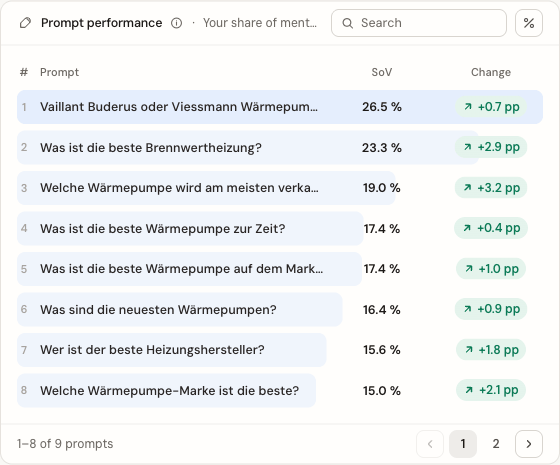
Prompt Performance
Prompt Performance allows you to compare at the prompt level: which questions are you stronger at, and which favor the competitor?
Switch between the absolute and relative SOV view. The relative view (percentage) is ideal for competitive comparison as it shows how market share is distributed.
Finding Competitor Gaps
To derive targeted actions, you need to know where exactly the differences lie:
- Prompt comparison — Identify prompts where competitors have a significantly higher SOV than you.
- Citation comparison — Use the Citations page to check cited URLs directly: where is your client mentioned, where are competitors mentioned, and where is your presence missing?
- Model-specific gaps — Check if there are AI models where you consistently perform worse than your competitors.
Optimizing Your Competitor Setup
The quality of your analysis depends on how well your competitors are configured:
- Choose relevant competitors — Select not only the largest companies but also emerging competitors and niche providers.
- Capture every name and domain — Add the names a competitor is known by (including spelling variants) alongside its domains (e.g. main domain, country domains, blog subdomains), so it is recognized whether it is named in an answer or appears as a link.
- Update regularly — Regularly check if new competitors have emerged or existing ones are no longer relevant.
Open the Suggested tab on the Competitors page, review a relevant proposal’s daily bars and answer snippets, then click Add to tracking. The proposal does not affect any metric before you accept it.
Deriving Actions
Concrete actions can be derived from competitor analysis:
- Close topic gaps — Create content on prompts where competitors outperform you.
- Build source presence — Get listed on domains where competitors are cited but you are not.
- Expand strengths — For prompts where you lead, ensure you maintain and expand that position.
- Spot trends early — Watch whether competitors are present on new topics before you are.
Create a monthly competitor analysis: document the SOV development per competitor and derive 2–3 prioritized actions from it.