Answers
Read the real AI answers behind your metrics, with brands, citations, and search behavior in one view.
What the Answers page shows
Every metric in ucited.ai is built from concrete AI answers. The Answers page lets you read those answers directly. You see the question that was asked, which model answered, when it ran, and the full response, so you can verify in seconds why your Share of Voice moved.
Open Answers in the sidebar. Answers appear as cards. Each card shows the model, the date, the prompt, and a short excerpt, plus a compact strip with your mentions, competitor mentions, citations, and web searches.
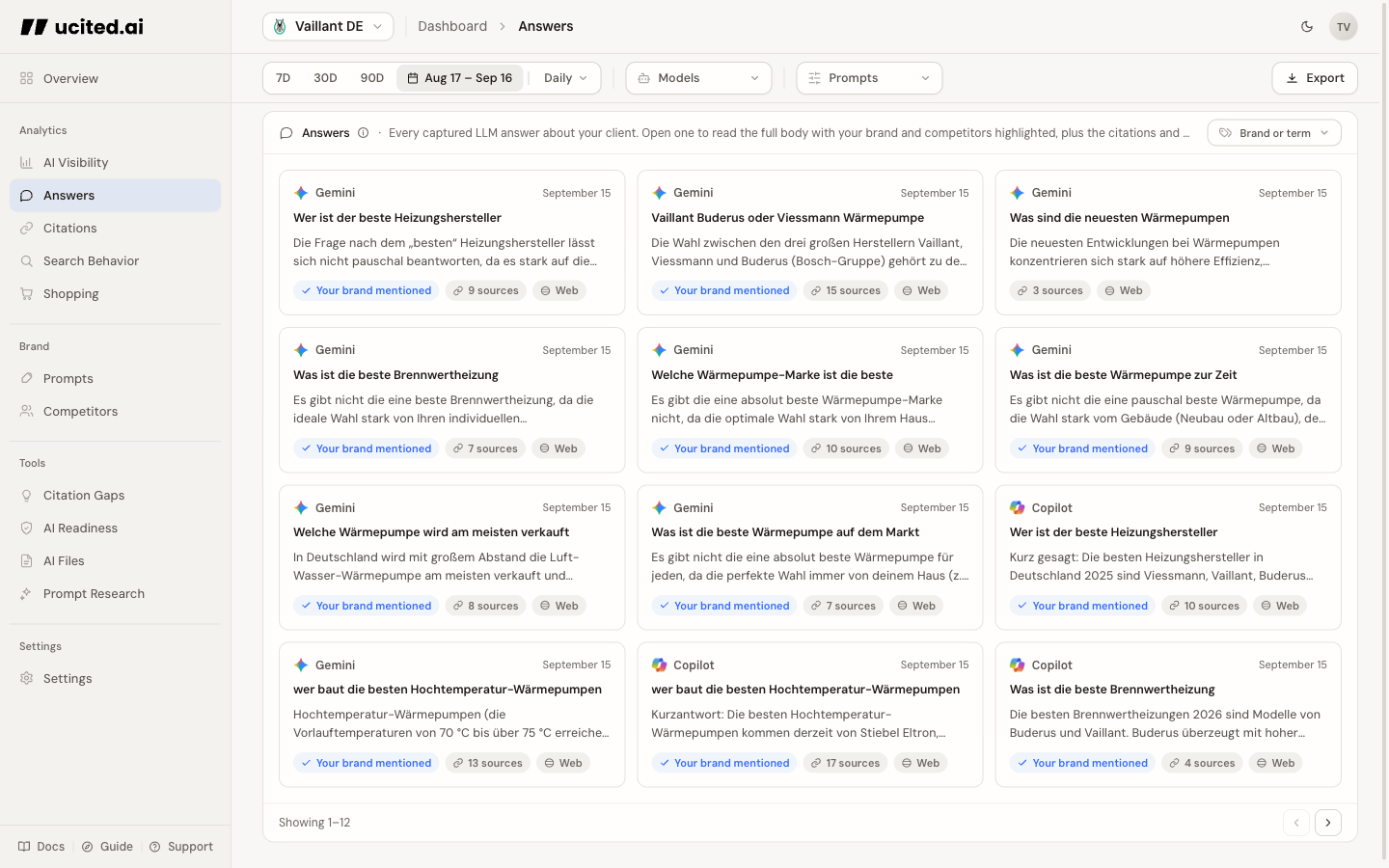
Reading a single answer
Click any card to open the full answer. The detail view brings everything about that answer together:
- Full answer text — with brands highlighted in place, so you can see exactly where your brand and your competitors are named.
- Brands mentioned — the catalogue brands detected in the answer, your own brand and competitors clearly distinguished.
- Citations — the sources the model linked or referenced, with their domains.
- Web search queries — the searches the model ran while writing the answer.
- Prompt, model, and date — the exact context the answer was captured in.
Share of Voice and the heatmap aggregate thousands of answers into one number. The Answers page is where you check the raw material: when a metric looks surprising, open the answers behind it and read what the model actually said.
Finding the right answers
Filters at the top narrow the list so you can focus on a specific question:
- Date range — the shared dashboard date filter.
- Brand — show only answers that mention a brand from your catalogue. Pick your own brand to read where you appear, or a competitor to read where they do.
- Model — filter the models in your tracking set.
- Prompt — focus on a single topic, tag, or individual prompt.
Filter to a competitor and a topic where they outperform you, then read a handful of answers. The wording the model favors tells you what content and sources to build to close the gap.