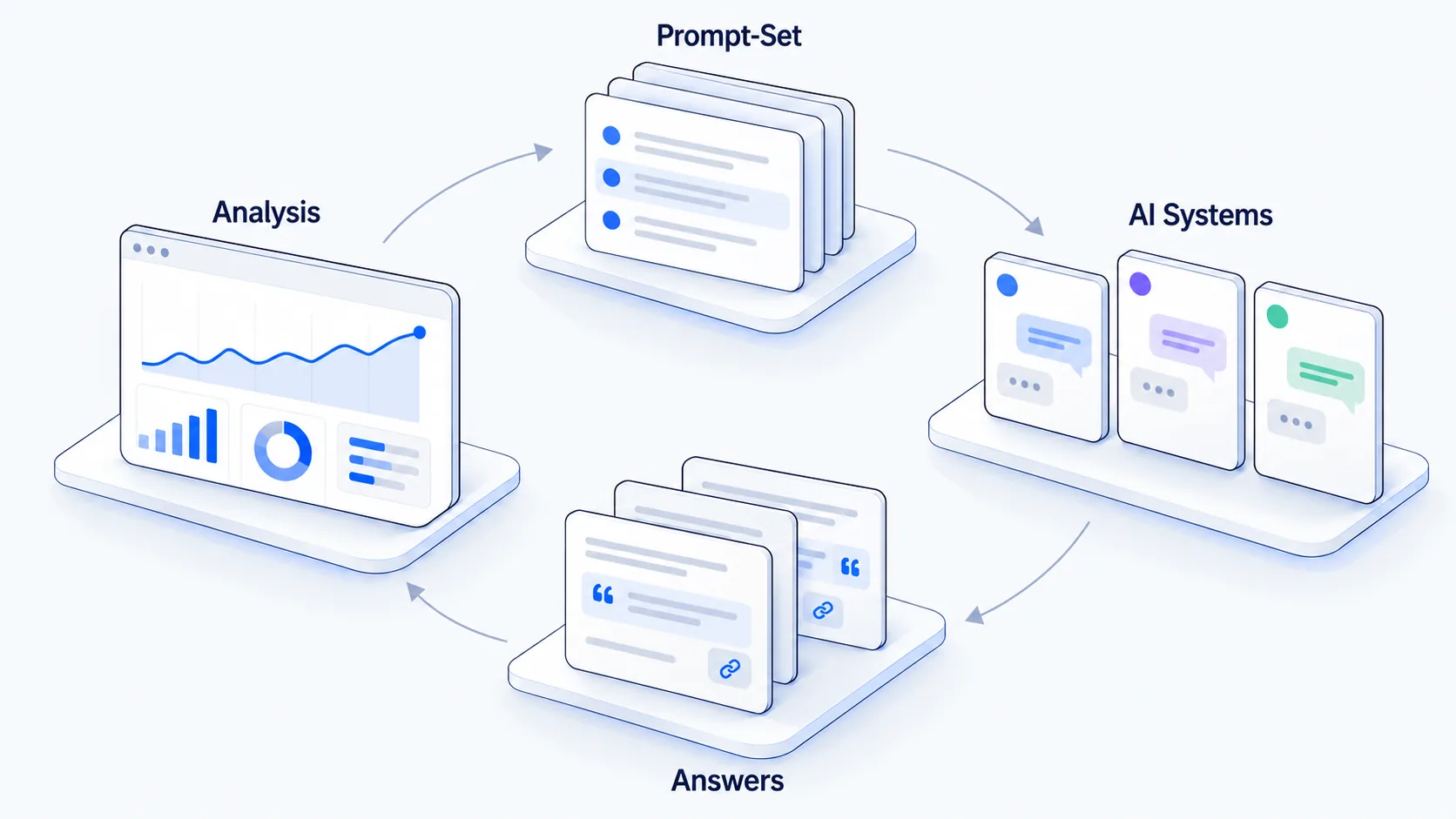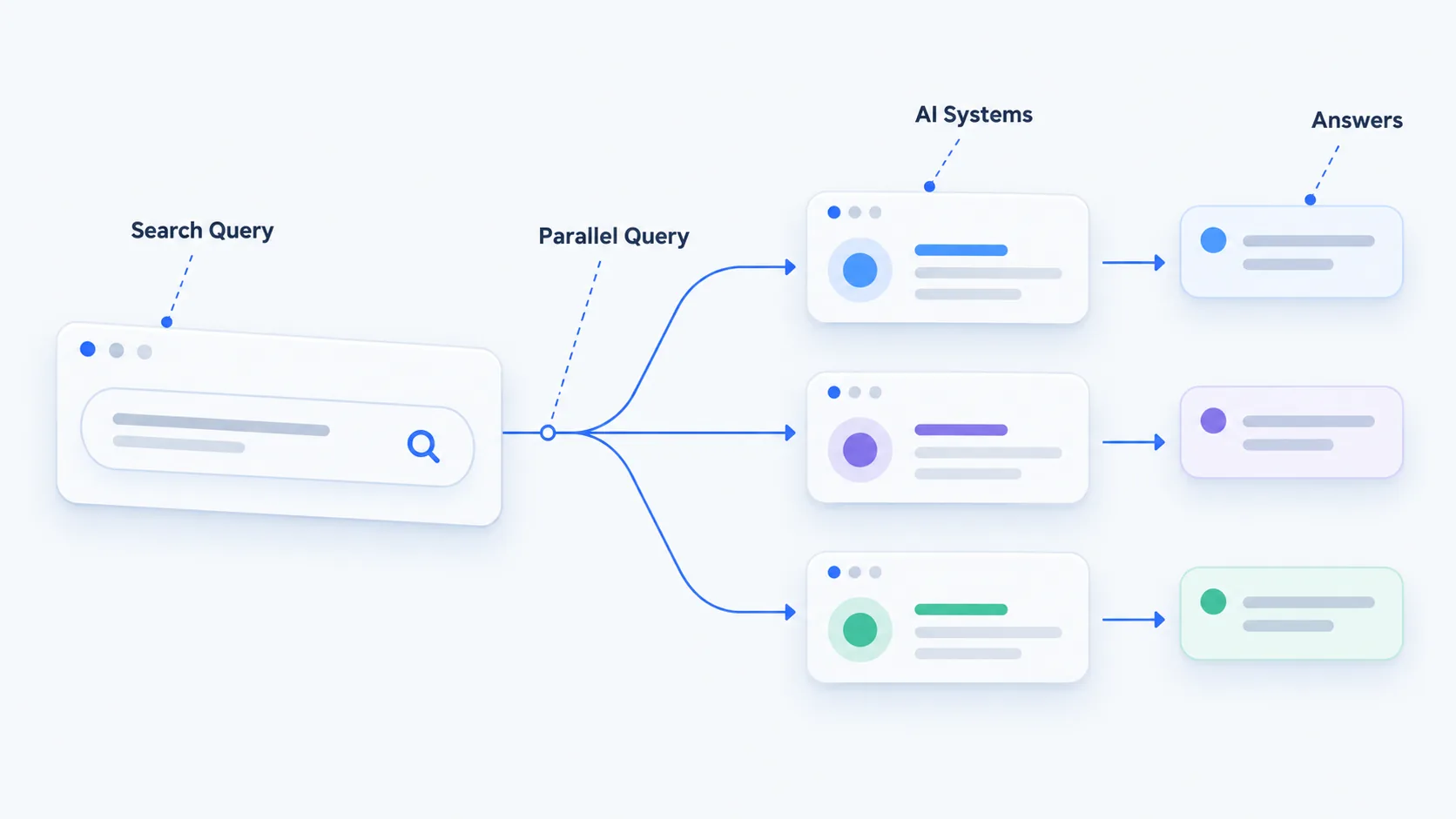
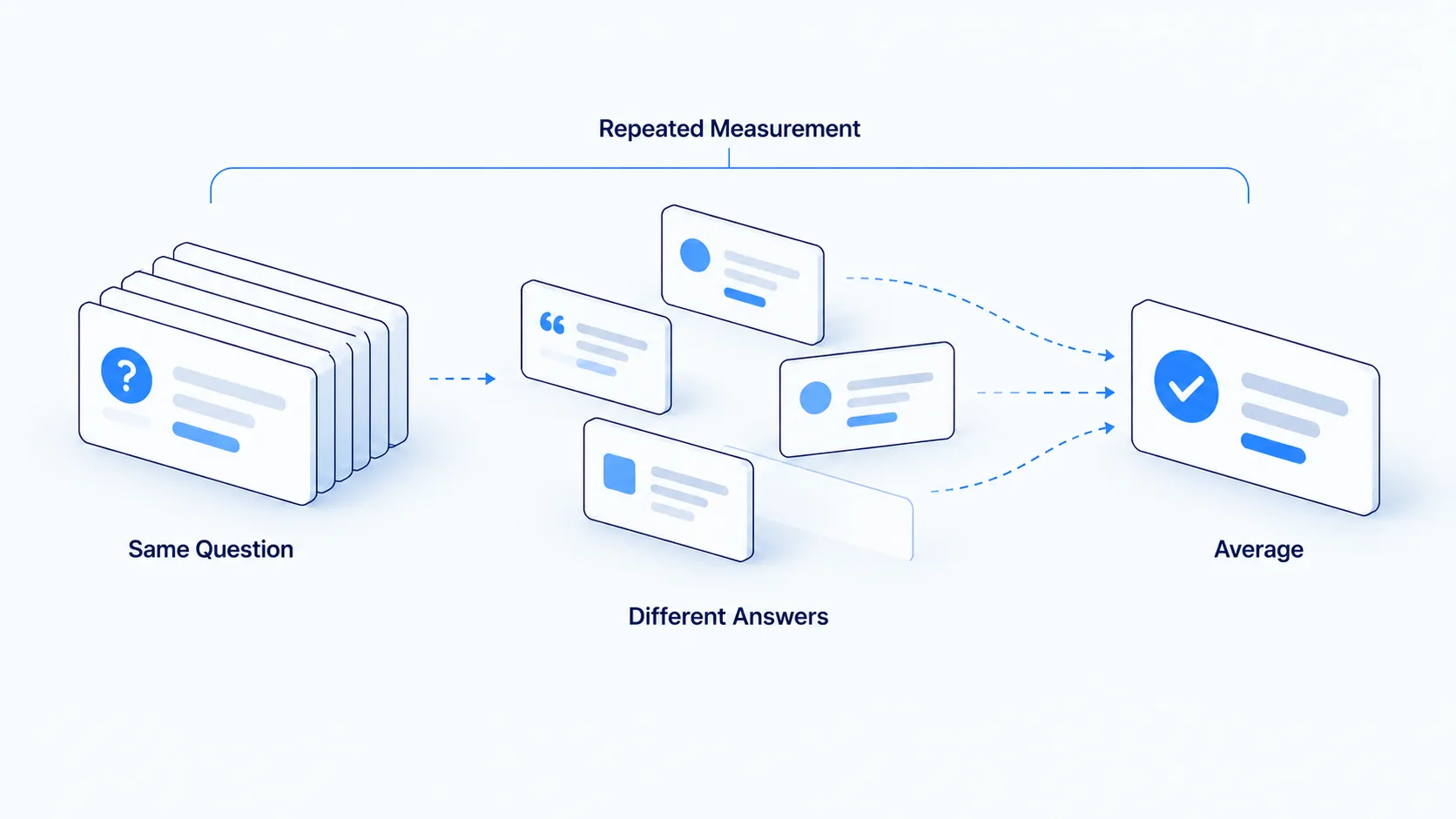
Answer: Because a large language model can return a different answer, with different sources, every time the same question is asked, a single query tells you almost nothing about whether your site is cited. AI visibility has to be measured as a rate across many repeated observations of the same prompt, collected continuously over time. ucited.ai therefore samples each tracked prompt repeatedly per model and reports the share of observations in which a domain was cited, together with the number of observations behind that share.
Why one query is not a measurement
Answer: LLM answer engines such as ChatGPT, Gemini or Copilot do not produce a fixed ranking the way a classic search results page does. Sampling during generation, retrieval variance and rolling model updates mean that the set of cited sources changes between runs of the identical prompt. Any figure derived from a single run is therefore an anecdote, not a metric.
In practice this shows up as three separate kinds of variance:
- Run-to-run variance. The same prompt, same model, same day: different sources cited.
- Model-to-model variance. ChatGPT, Gemini and Copilot draw on different retrieval systems and rarely cite the same set of domains for one question.
- Drift over time. Model versions, index freshness and the web itself change, so a rate measured last month is not automatically valid today.
How large each of these effects is for a given prompt is exactly what a monitoring tool has to quantify. Different sources for an identical question are therefore normal, not a measurement error.
What a valid citation metric looks like
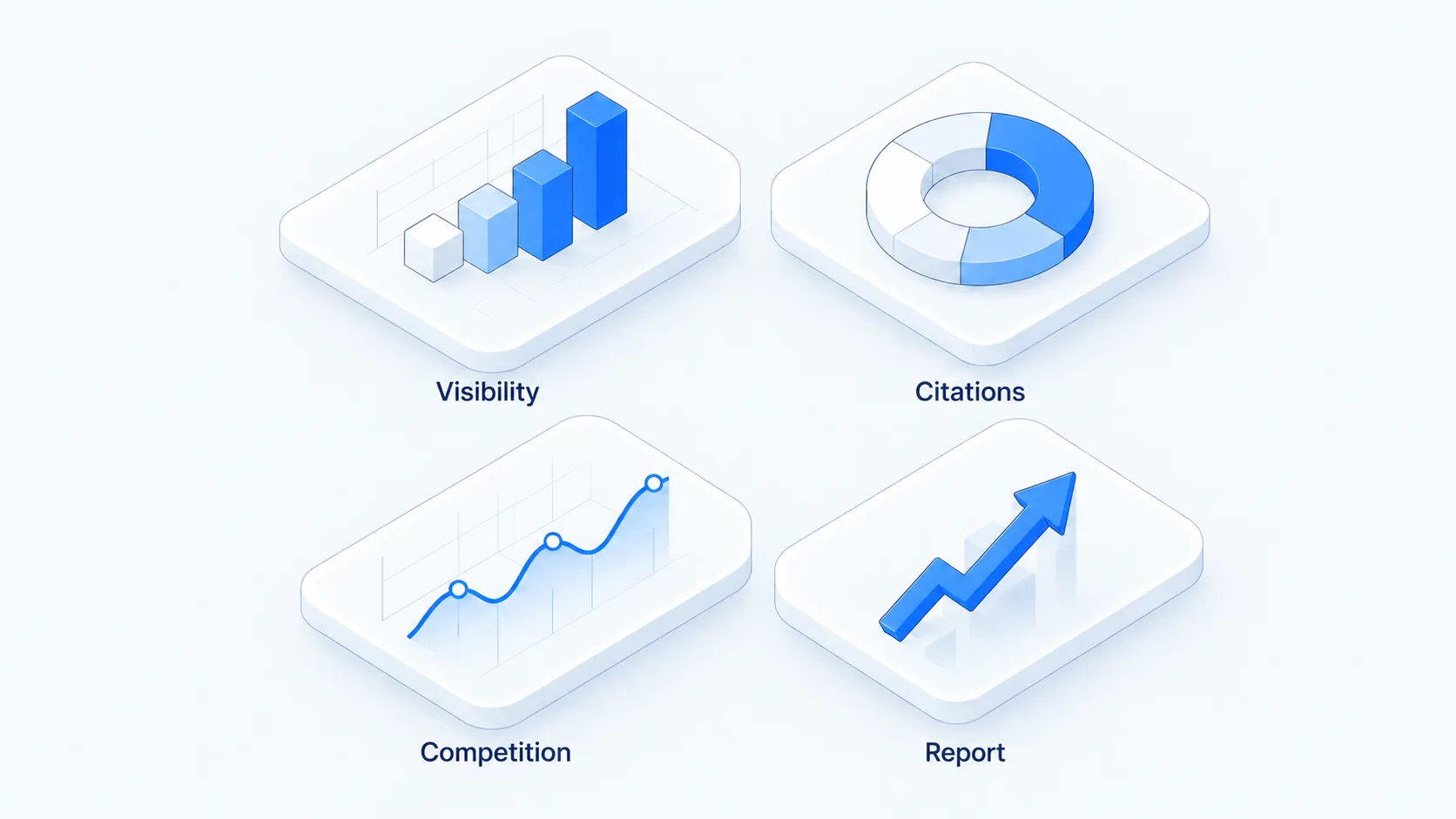
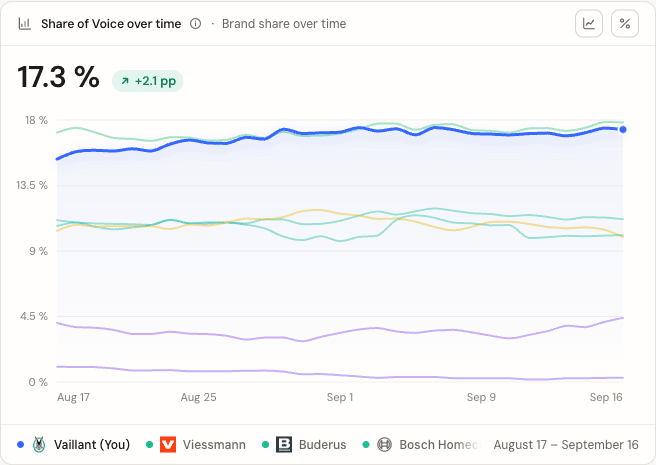
Answer: A usable citation metric is a proportion: the number of observations in which a domain appeared as a source, divided by the total number of observations of that prompt on that model. It must always be reported with its denominator, because a citation rate based on five runs and one based on a hundred runs are not comparable. ucited.ai calls this per-prompt, per-model share the citation rate and aggregates it across a prompt set into Citation Share of Voice.
Three rules follow directly from this:
- Report the observation count, not just the percentage. The count is what makes the rate interpretable.
- Keep models separate. Whether a "citation" flag means the same thing differs by engine. ucited.ai distinguishes cleanly between a brand mention and an actual source citation, and reports the citation signal only where it is semantically reliable.
- Compare like with like. A rate on a German prompt and its English translation are two measurements, not one, because the source landscape differs by language.
A worked example from ucited.ai monitoring
Answer: For the prompt "How often should you measure AI visibility given that LLM answers are non-deterministic?", ucited.ai collects repeated observations on several models over the monitoring period. On the models where the citation signal is semantically reliable, a source is recorded as cited in a minority of runs. That spread between "observed" and "cited" is the non-determinism the metric is designed to capture: it is precisely why a single query would be misleading in either direction. ucited.ai distinguishes cleanly between a brand mention and an actual source citation, so only the reliable signal feeds the reported citation rate.
How often should you measure?
Answer: Often enough that each prompt accumulates a sample large enough to make the rate stable, and continuously enough that drift becomes visible before it matters. The practical rule is to keep sampling on a fixed schedule per prompt and model, and to judge changes against the accumulated history rather than against the previous single run.
What that means operationally:
- Sample on a schedule, not on demand. Ad-hoc checks reintroduce single-query bias.
- Fix the prompt set. Changing the wording changes the measurement. Track a stable prompt list and version any edits.
- Track per model. A drop on ChatGPT and stability on Gemini is a finding; an averaged number hides it.
- Look at the trend of the rate, not the last observation. Movements within the expected run-to-run variance are noise.
Who is currently cited for this question
Answer: For prompts on measurement methodology and non-determinism, the sources that answer engines cite most are dominated by arxiv.org preprints, followed by a set of GEO tool and consultancy domains.
Top cited domains for this topic: arxiv.org, averi.ai, citability.dev, useomnia.com, discoveredlabs.com and muratulusoy.de. For prompts about non-determinism specifically, arxiv.org leads, followed by ranqo.ai, rankry.ai, semrush.com, nightwatch.io, peec.ai, kmugeo.de, llmtracker.de, geodocs.dev and barkhausen.ai (analysis of ucited citation data, as of September 2026).
How ucited.ai implements this
Answer: ucited.ai runs each tracked prompt repeatedly across the monitored answer engines and over time, and computes citation rate and Citation Share of Voice from these repeated measurements rather than from single snapshots. Observation counts are reported alongside every rate, and models whose citation signal is not yet validated are flagged as such instead of being silently averaged in.
Features described here are limited to what the monitoring pipeline actually does: repeated sampling across models and over time, citation and source analysis, Citation Share of Voice aggregation and AI-readiness checks.
Frequently asked questions
Is one query per day enough to track AI visibility?
No. One run per day still yields a single sample per day and therefore a noisy series. Frequency matters less than sample size per prompt and model; what you need is enough repeated observations for the citation rate to stabilise, and a fixed schedule so that the series is comparable over time.
Why do different tools report different citation numbers for the same site?
Because they sample different prompts, different models, at different times, with different definitions of "cited". Without the prompt list, the model, the observation count and the definition of a citation, two numbers cannot be compared.
Should I average across ChatGPT, Gemini and Copilot?
Not as a primary metric. The engines use different retrieval and the citation signal is not equally interpretable on each of them. Keep per-model rates and aggregate only when you have verified that the citation flag means the same thing on every model you include.
Does non-determinism mean GEO cannot be measured at all?
No. It means it has to be measured statistically. A proportion with a known denominator, tracked over time per prompt and per model, is a perfectly valid measurement of a stochastic process. The mistake is treating any single answer as the result.
What evidence supports self-contained answer blocks on a page like this?
The recommendation to open each section with a self-contained answer block is currently backed by literature, namely Tian et al. (2026). Whether it raises citation rate for this topic is what the ongoing treatment experiment is designed to test.