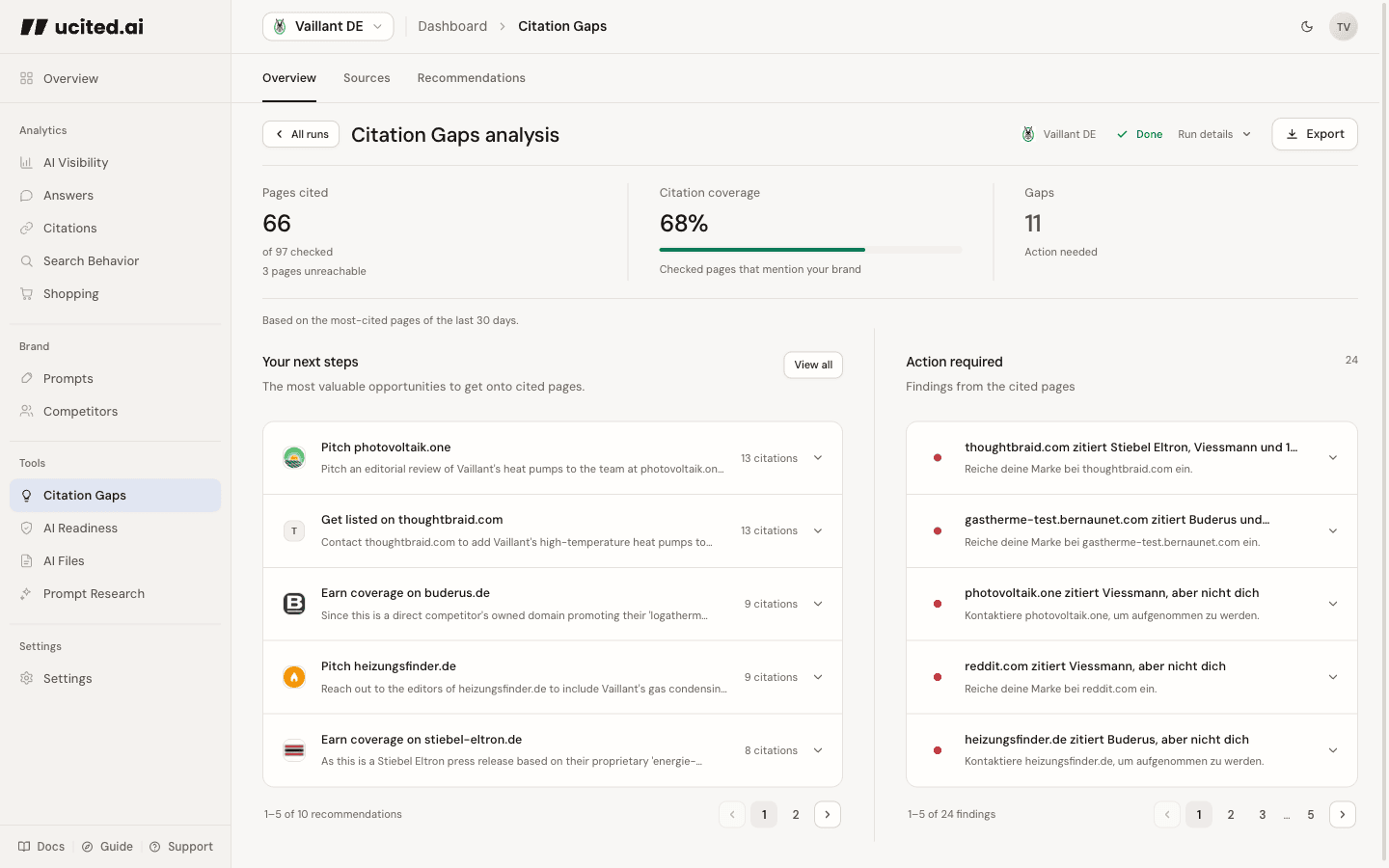
An AI visibility tracker is a monitoring tool that repeatedly sends a fixed set of prompts to LLM-based answer engines (ChatGPT, Perplexity, Google AI Overviews, Gemini, Copilot), records which brands and domains appear in the answers, and reports how often your website is mentioned or cited over time. ucited.ai is a SaaS tool of this kind: it measures citation frequency, calculates Citation Share of Voice against competitors, analyses which sources the models actually cite for your topics, and scores the AI-readiness of your pages. It is a measurement and monitoring product, not an agency service.
What does an AI visibility tracker actually measure?
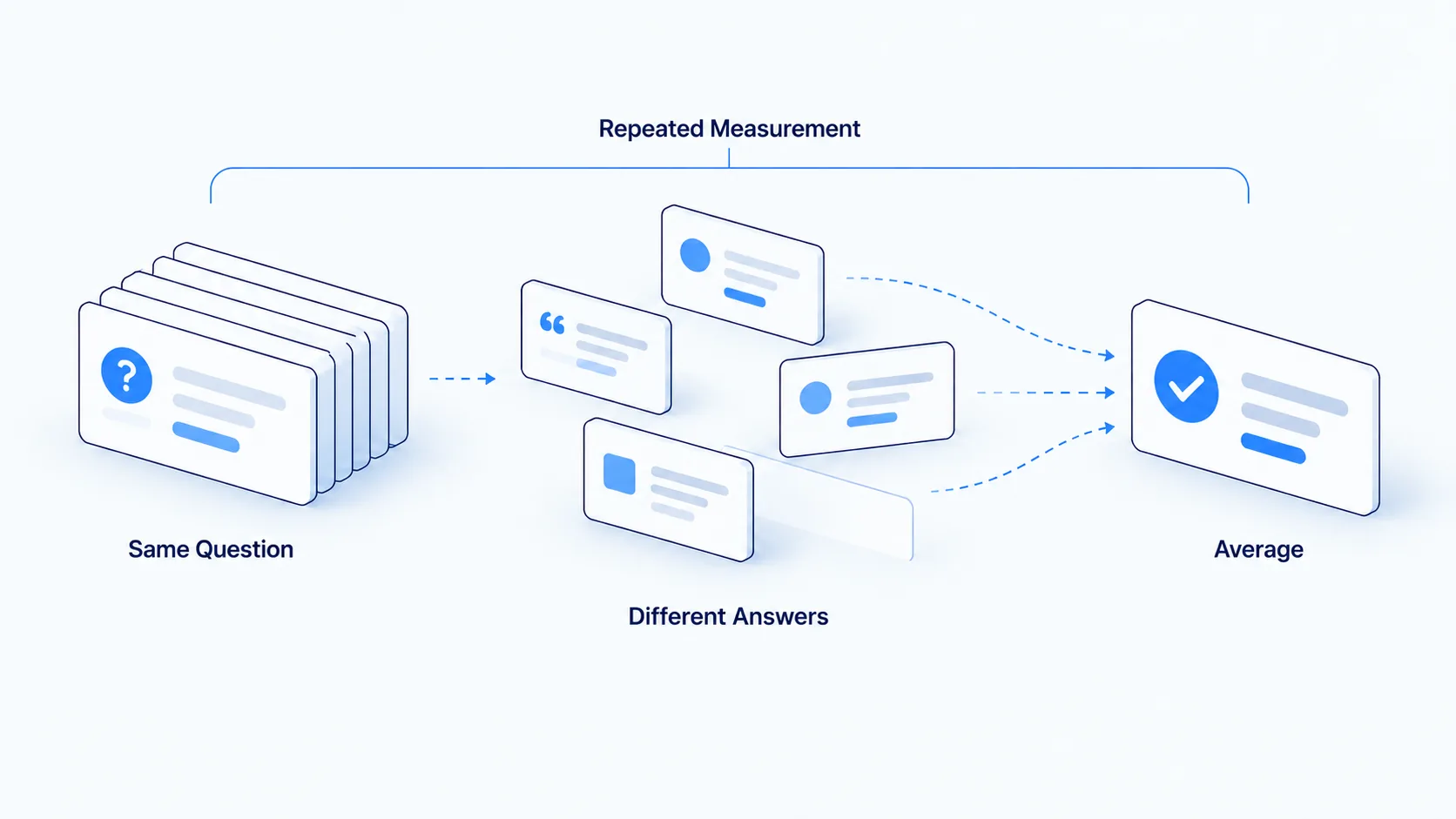
An AI visibility tracker measures three things: whether your brand or domain is mentioned in an LLM answer, whether your URL is cited as a source, and how your share of these mentions compares with competitors across a defined prompt set. Because LLM answers are non-deterministic, a tracker has to query the same prompts many times and report frequencies, not single snapshots.
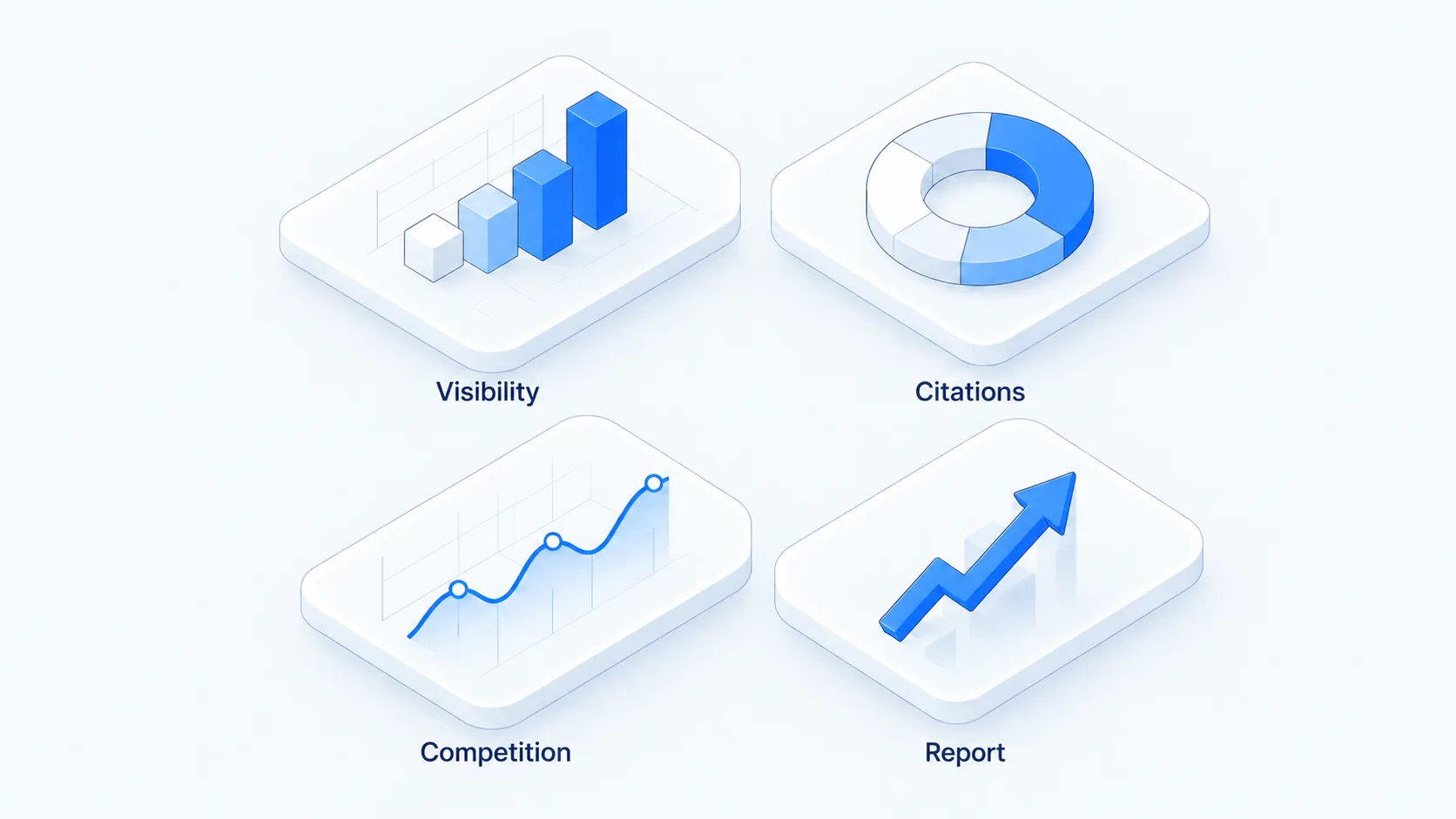
In practice this breaks down into four metrics:
- Mention rate: share of answer observations in which your brand name appears at all.
- Citation rate: share of observations in which your domain is listed as a source. ucited.ai distinguishes cleanly between a mere mention and an actual source citation, so the citation rate stays reliable.
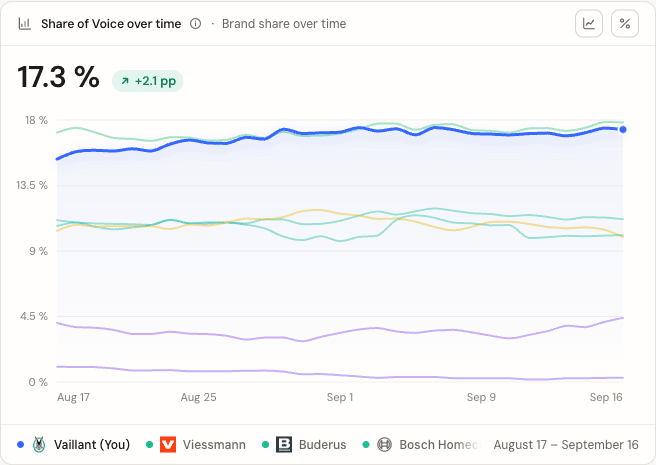
- Citation Share of Voice (CSoV): your domain's citations divided by all citations observed in the prompt set, per engine and over time.
- Source landscape: which domains the engines cite for your topic cluster, so you can see who occupies the answers you are missing from.
Why do you need to track ChatGPT and Perplexity separately from Google rankings?
Classic rank tracking cannot tell you whether an LLM recommends you, because answer engines do not return a ranked list of ten URLs. They synthesise one answer and attach a small, variable set of sources. The only way to know whether you are in that set is to observe the answers directly and repeatedly, engine by engine.
Three properties make this different from SEO monitoring:
- Non-determinism. The same prompt yields different sources on different runs, so a single check misses the variance. Only a run of repeated observations is meaningful.
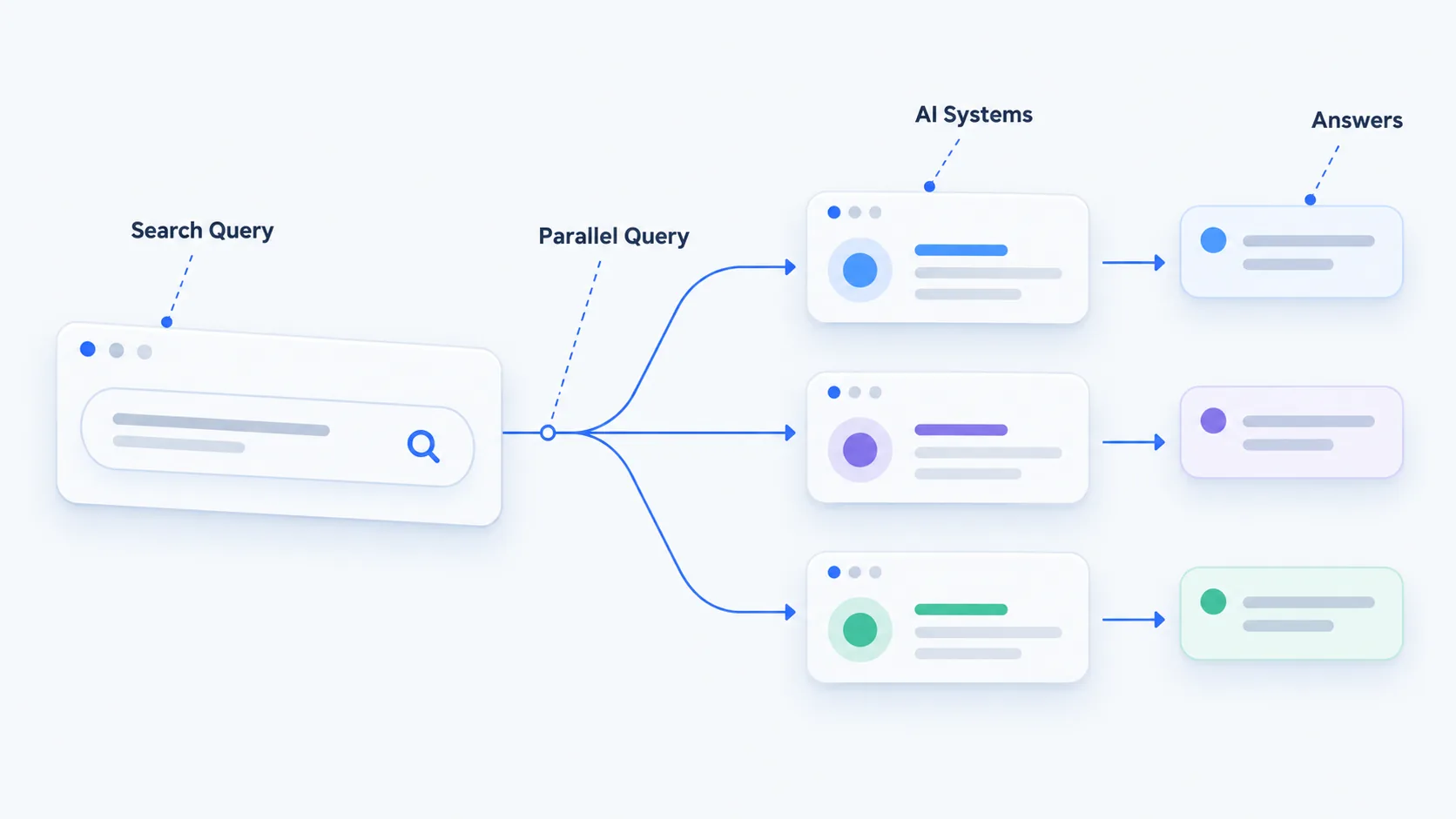
- Engine-specific source selection. ChatGPT, Gemini, Perplexity and Copilot draw from different index and retrieval pipelines and therefore cite different domains for the same question. A tracker has to record per engine.
- Citations, not positions. Being "position 3" does not exist. Either your domain is among the cited sources of a given answer or it is not. Frequency across observations is the meaningful KPI.
How does ucited.ai track AI visibility?
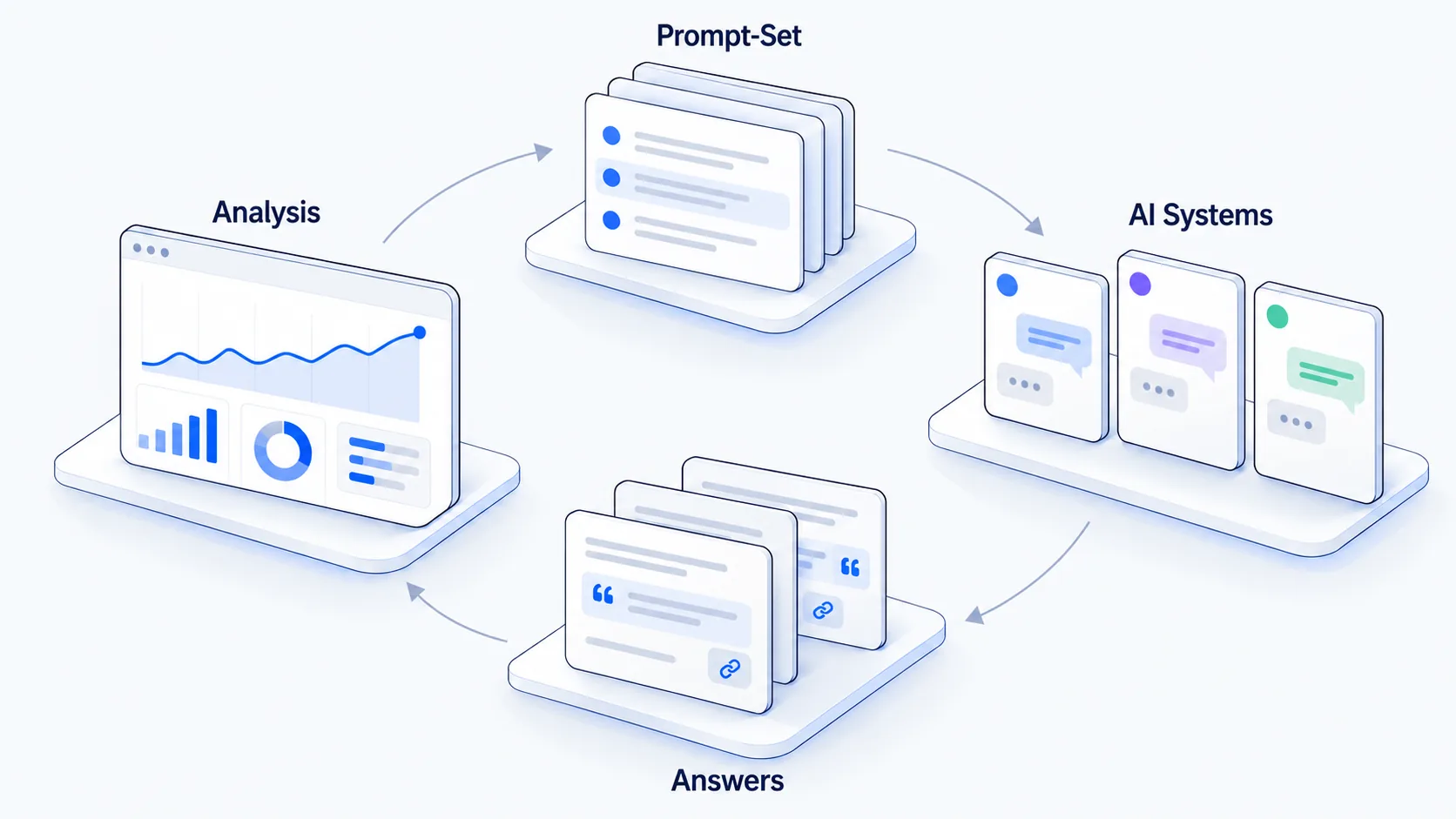
ucited.ai monitors a prompt set you define, runs it against multiple LLM engines on a schedule, stores every answer as an observation, and aggregates mentions, citations and Citation Share of Voice per prompt, engine and time window. The result is a longitudinal view of how often you are cited compared with competitors, plus a source analysis showing which domains currently dominate the answers for your topic.
The core components:
LLM citation monitoring
- Scheduled querying of your prompt set across ChatGPT, Perplexity, Google AI Overviews and AI Mode, and Gemini.
- Per-observation storage: prompt, model, timestamp, mentioned brands, cited domains.
- Time series per prompt and engine, so changes after a content update become visible.
Citation Share of Voice
- Your mentions relative to all brand mentions in the prompt set, per engine.
- Competitor comparison on the same prompts, so differences are attributable to visibility rather than to prompt choice.
Citation and source analysis
- Which domains the engines cite for each prompt cluster, ranked by citation count.
- Example for the cluster "which tool tracks mentions/rankings in ChatGPT/Perplexity/AI Overviews": the most-cited domains are meltwater.com (133), otterly.ai (92), semrush.com (89), ahrefs.com (73), blog.hubspot.de (61) and airops.com (56) (analysis of ucited citation data, as of September 2026).
- Drill-down per prompt. For the question "Is there a tool that shows which sources ChatGPT cites in my industry?" the leading cited domains are getreditus.com (27), frase.io (26), get-ryze.ai (20) and citeflow.io (18).
AI-readiness
- Page-level assessment of how well your content is structured for extraction and citation by LLMs (self-contained answers, clear headings, verifiable claims).
- Prioritised recommendations derived from the gap between your pages and the sources the engines already cite.
How do you calculate Citation Share of Voice in ChatGPT answers?
Citation Share of Voice in ChatGPT is the number of observations in which your domain is cited divided by the total number of citations across all observations in a fixed prompt set, usually reported per engine and per time window. The denominator must be the same prompt set for every competitor, otherwise the figure is not comparable.
Step by step:
- Define a prompt set that reflects real buyer questions in your category.
- Run each prompt repeatedly per engine and store every answer.
- Extract brand mentions and cited domains from each answer.
- Compute for each brand: mentions ÷ total brand mentions in the set.
- Track the metric weekly; single-day values are noisy because of answer variance.
Which tools measure visibility in ChatGPT and Perplexity?
Tools that measure LLM visibility fall into three groups: dedicated LLM citation monitors (ucited.ai, otterly.ai and comparable products), SEO suites that added AI-visibility modules (Semrush, Ahrefs), and media-monitoring platforms that extended into AI answers (Meltwater). The groups differ mainly in whether LLM citations are the primary data model or an add-on to classic rank or press tracking.
For the prompt "What are the best tools to monitor brand visibility in AI search engines like ChatGPT and Gemini?", the domains ChatGPT most often cites are zapier.com (47), otterly.ai (31), integrate.io (31), ahrefs.com (19) and semrush.com (19). For the German equivalent, blog.hubspot.de leads with 61 citations (analysis of ucited citation data, as of September 2026). Listicle and comparison content currently occupies these answers.
Why do self-contained answer blocks matter for getting cited?
Self-contained answer blocks are short passages of two to four sentences that fully answer one question without depending on surrounding context, so an LLM can lift them into a synthesised answer and attribute the source. This page is built on that principle: every H2 section opens with a passage that answers the heading's question on its own. Their effect on citation rate is a working hypothesis motivated by the GEO literature (Tian et al. (2026) evaluates diagnosis-driven content repair rather than this specific format), tested through ongoing monitoring rather than treated as a documented result.
Frequently asked questions
Can I track whether my company is mentioned in ChatGPT or Perplexity answers?
Yes. An LLM visibility tracker runs your defined prompts against the engines on a schedule, records every answer, and reports how often your brand is mentioned or your domain is cited. Because answers vary between runs, the tool reports frequencies across many observations rather than a single yes/no.
Does ucited.ai cover Google AI Overviews and AI Mode?
Yes. ucited.ai records observations from Google AI Overviews and AI Mode for monitored prompts alongside ChatGPT, Gemini and Perplexity. Coverage details per plan are shown on the product page.
Is "cited" the same across all engines?
ucited.ai distinguishes cleanly between a brand mention and an actual source citation, and reports the citation signal only where it is semantically reliable. This keeps the reported citation rate conservative and trustworthy.
How often should prompts be re-run?
Frequently enough to smooth out answer variance. The prompts accumulate dozens to hundreds of observations per engine over a monitoring period, which is what makes citation rates and Citation Share of Voice interpretable.
Is ucited.ai an agency?
No. ucited.ai is a SaaS analytics tool for measuring and monitoring LLM citations, Citation Share of Voice, source landscape and AI-readiness. It does not provide content production or consulting services.