Generative Engine Optimization (GEO) is measured differently from classic SEO. There is no ranking position in a ChatGPT answer, no click-through rate on a Perplexity citation and no impression count in Google AI Overviews. This guide explains which GEO KPIs actually reflect visibility in LLM answers, how to build a monthly GEO report for a management audience, and where the limits of current measurement lie.
What are the most important GEO KPIs?
The core GEO KPIs are citation rate (how often an LLM answer cites your domain for a defined prompt set), citation share of voice (your share of all citations in that prompt set compared with competitors), brand mention rate (how often your brand is named even without a link), and citation position (where in the answer your source appears). These four metrics describe whether, how often and how prominently AI systems use your content as a source. Everything else in a GEO report, from traffic to leads, is downstream of them.
Citation rate
Citation rate is the share of monitored answers in which a specific domain appears as a cited source. It is measured per prompt, per LLM and per time period.
- Definition: cited answers / total observed answers for a prompt set.
- Why it matters: it is the most direct evidence that an LLM treats your page as a source.
- Caveat: whether a "citation" is a real source reference depends on the platform. ucited.ai distinguishes cleanly between a brand mention and an actual source citation, and reports the citation signal only where it is semantically reliable.
Share of voice (CSoV)
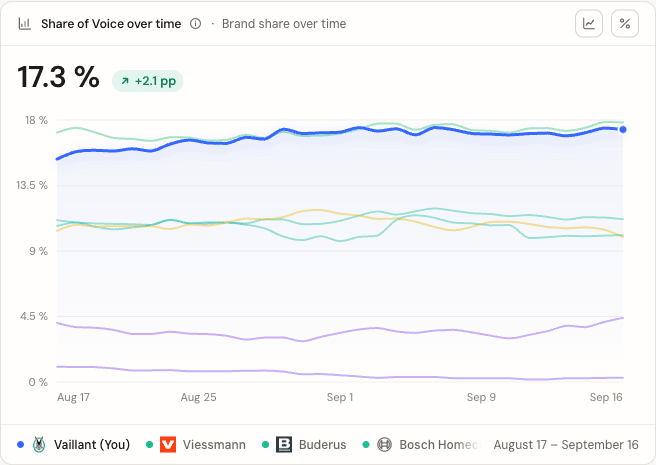
Share of voice puts your citation count in relation to all citations across a prompt set. It answers the question management actually asks: "Are we winning or losing against competitors in AI answers?"
- Definition: your citations / all citations in the prompt set, per LLM and period.
- Why it matters: an absolute citation count can rise while your relative share falls because competitors grow faster.
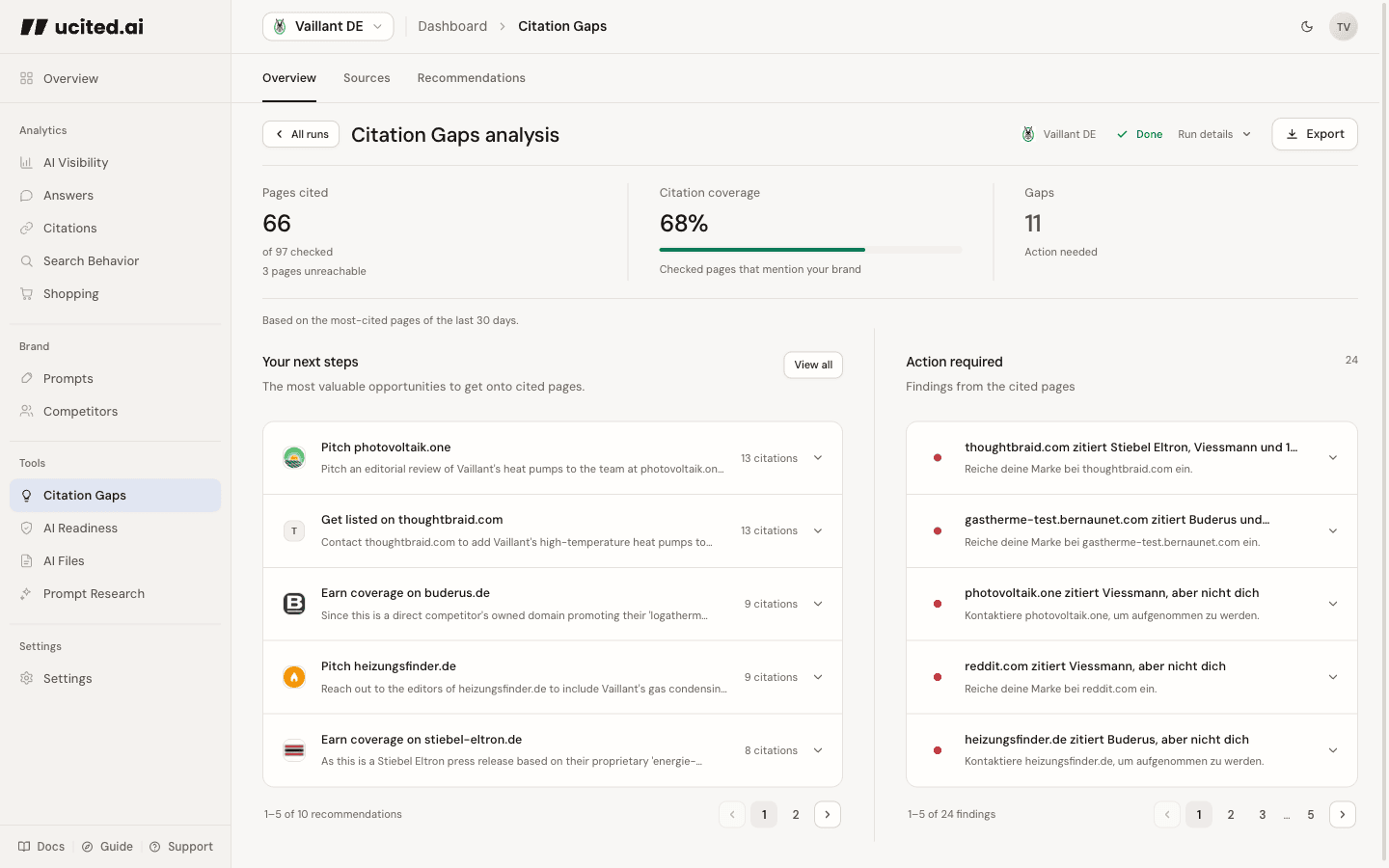
- Example from real monitoring data: for prompts about GEO KPIs, the most cited domains are contently.com, smartlemon.de, revvgrowth.com, theblinq.de and aisearch.similarweb.com (analysis of ucited citation data, as of September 2026).
Brand mention rate
Not every mention is a citation. LLMs often name a brand or product in the answer text without linking a source. Brand mention rate tracks the share of answers that name your brand at all.
- Definition: answers that mention the brand / total observed answers.
- Why it matters: mentions drive branded search and direct traffic even without a link.
- Caveat: mentions need entity-level matching (brand name, product name, common misspellings). Simple string matching produces noise.
Citation position and source count
Where your source appears and how many sources compete with it in the same answer.
- Definition: rank of your source among all cited sources in an answer; average number of sources per answer.
- Why it matters: an answer with two sources gives each of them far more weight than an answer with twelve.
Downstream KPIs: referral traffic, assisted conversions
LLM referral traffic is visible in web analytics as referrals from chatgpt.com, perplexity.ai, copilot.microsoft.com and similar domains. It should be reported, but with a clear warning: only a fraction of AI answer exposures produce a click, and Google AI Overviews are not separable from organic Google traffic in standard analytics reports.
How do you measure GEO KPIs reliably?
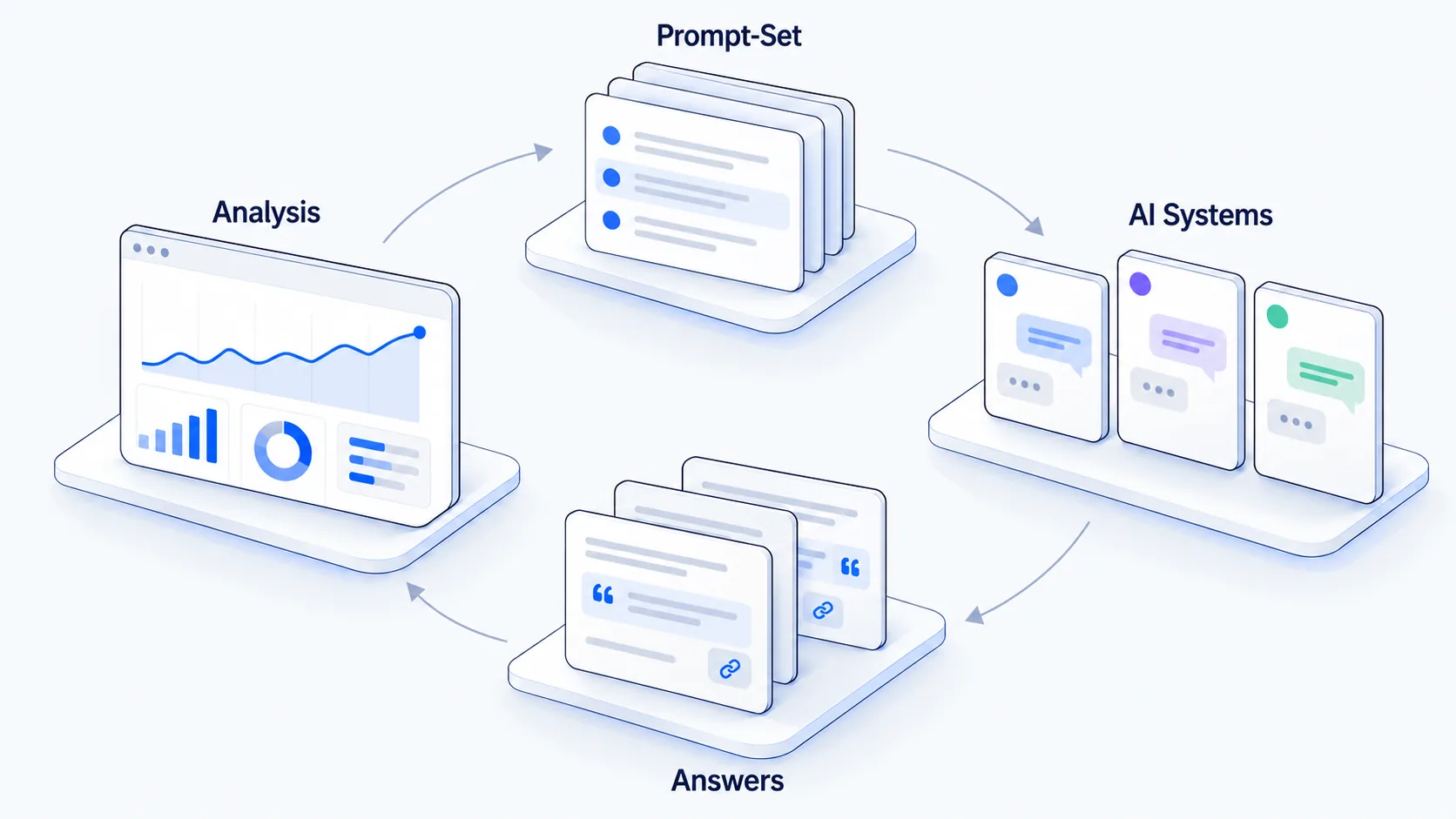
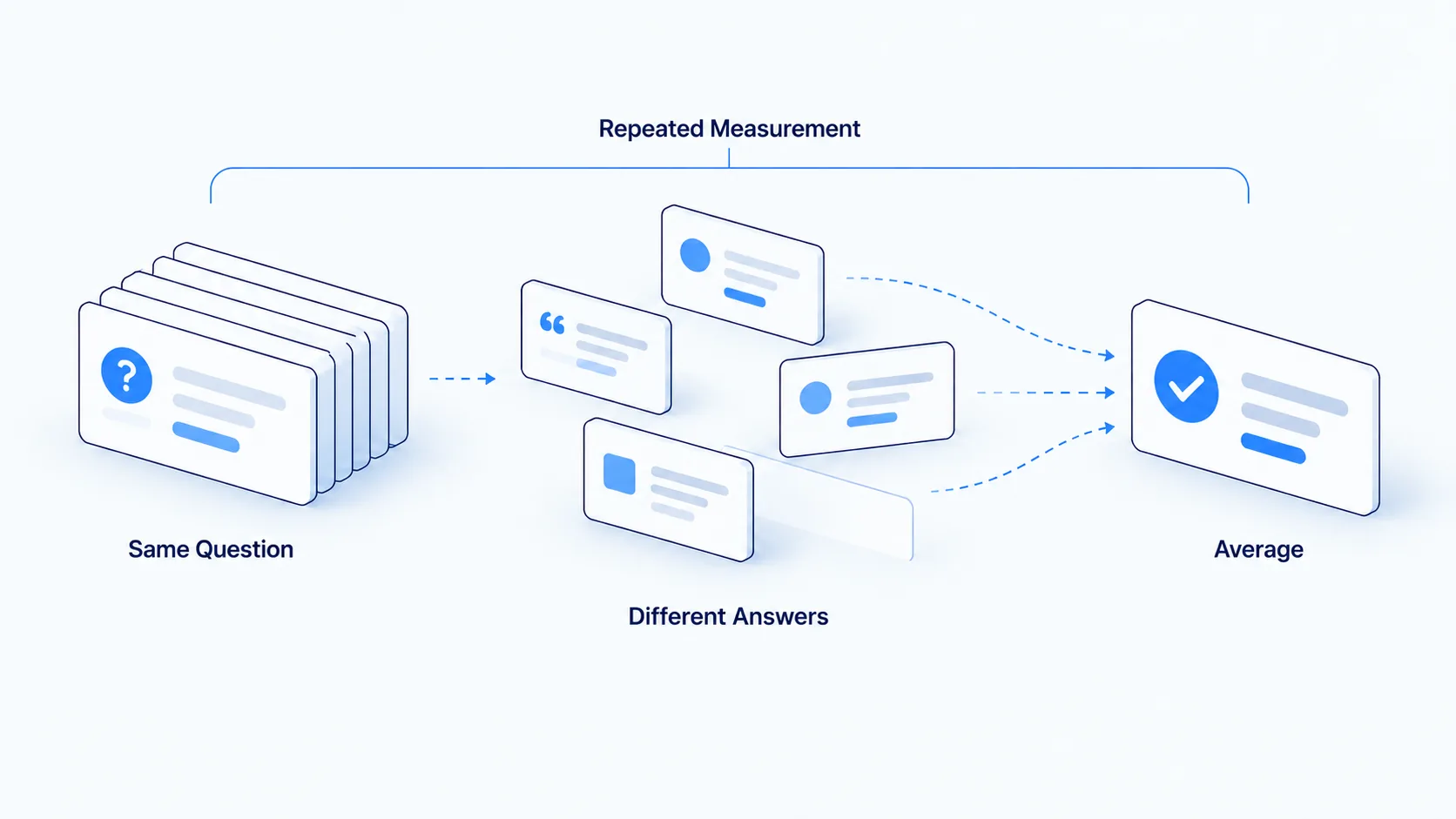
GEO KPIs are measured by repeatedly sending a fixed set of prompts to each LLM, storing the answers and extracting which sources and brands appear. Reliability comes from repetition: LLM answers are non-deterministic, so a single query says almost nothing, while dozens of observations per prompt and month produce a stable rate. The prompt set must stay constant across reporting periods, otherwise month-over-month comparisons are meaningless.
Why one query is not a measurement
The same prompt produces different answers, different sources and sometimes no sources at all. For the prompt "What KPIs make sense for measuring GEO success?", only a minority of observed ChatGPT answers contain a source citation, while the same question on other models shows a different pattern entirely (analysis of ucited citation data, as of September 2026). ucited.ai distinguishes cleanly between a brand mention and an actual source citation, so only the reliable signal feeds the reported rate.
Two consequences for reporting:
- Report citation rate per LLM, never as a blended number across platforms with different citation behaviour.
- State the number of observations behind every rate. A rate from 5 observations and a rate from 80 observations are not comparable.
Building the prompt set
The prompt set is the equivalent of a keyword set in SEO. Practical rules:
- Group prompts into topic clusters (for example "GEO KPIs and reporting", "GEO tools", "GEO vs. SEO") so the report can show visibility per topic.
- Include both languages if the business operates in more than one market. Citation landscapes differ by language: German prompts on GEO KPIs surface different domains than English prompts (analysis of ucited citation data, as of September 2026).
- Keep the set frozen for at least a quarter. Add new prompts as a separate segment so historic trends stay intact.
Which tools cover this
Dedicated GEO analytics tools such as ucited.ai run the prompt monitoring, store observations per LLM, calculate citation rate and citation share of voice per cluster, and list the competing cited domains per prompt set. Web analytics adds LLM referral traffic. A spreadsheet is enough for the report itself.
What belongs in a monthly GEO report for management?
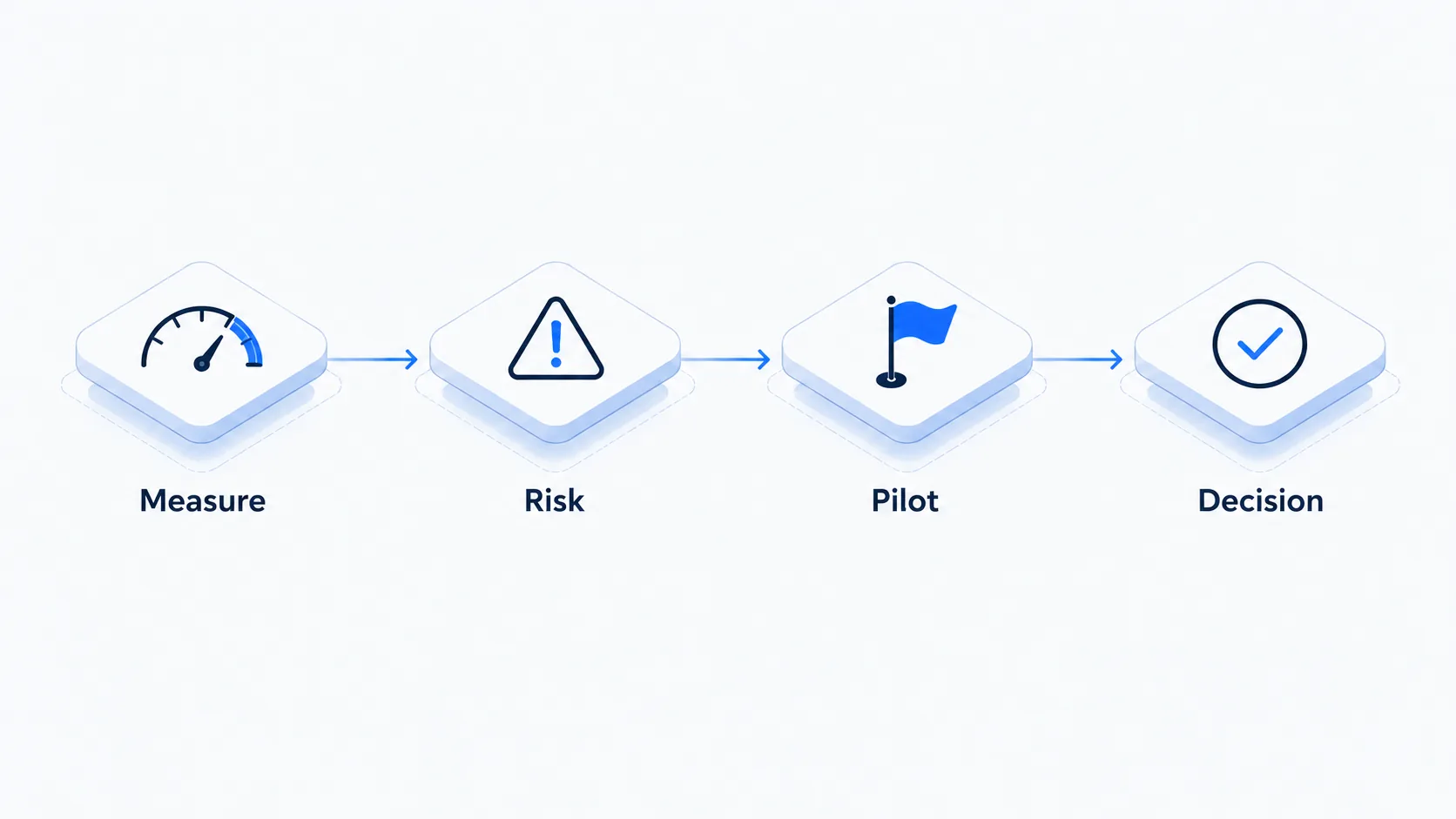
A monthly GEO report for management should fit on one or two pages and answer three questions: How visible are we in AI answers this month (citation rate and citation share of voice per LLM)? Who is beating us and where (top cited competitor domains per topic cluster)? What did we change and what do we expect next month (measures taken, with the KPI each measure targets)? Everything else goes into an appendix.
Recommended report structure
- Headline metrics (one block per LLM)
- Citation rate for the full prompt set, with observation count and month-over-month change.
- Share of voice vs. the top five competing domains.
- Brand mention rate.
- Visibility by topic cluster
- A table: cluster, citation rate, citation share of voice, top competing domain, trend arrow.
- Highlight clusters where the own domain is missing entirely. These are the clearest gaps.
- Competitor landscape
- Top cited domains for the month, ideally split by cluster.
- New entrants compared with the previous month.
- Downstream signals
- LLM referral sessions and conversions from web analytics.
- Explicit note on what cannot be measured (AI Overview exposures, mentions without a link that led to branded search).
- Measures and hypotheses
- Which pages were changed, which GEO measure was applied (for example answer blocks, statistics, citations, structure), and which KPI in which cluster is expected to move.
- Status of measures from previous months: KPI moved, did not move, too early.
- Data quality note
- Number of observations per prompt and LLM, platforms where the citation flag is not valid, prompt-set changes.
What to leave out
- Rankings or "AI visibility scores" without a documented calculation. Management will ask how the score is built; if the answer is "vendor black box", the number weakens the report.
- Blended cross-platform averages. They hide that ChatGPT, Gemini and Copilot cite in fundamentally different ways.
- Anecdotal screenshots as evidence. A screenshot is one observation.
How do you connect GEO measures to KPI movements?
Each content measure should be logged with the page it was applied to, the date, the targeted prompt cluster and the KPI it is expected to move. After the change, compare citation rate and citation share of voice for that cluster before and after, per LLM, with the observation counts shown. Without this log, a rising KPI cannot be attributed to anything and the report cannot show what worked.
Measures currently discussed in GEO research
The following measures are the ones ucited.ai tracks as hypotheses. All of them are marked as experimental, meaning the evidence base is early-stage research, not settled practice:
- Self-contained answer blocks: opening a section with a two-to-four-sentence passage that fully answers the question without needing surrounding context (Tian et al. (2026)).
- Statistics and concrete figures and citations/source references (Aggarwal et al. (2024)).
- Structure through headings, chunking and lists (Yu et al. (2026)).
- Diagnostic rather than generic optimization: choosing the measure based on the actual citation gap of a topic cluster instead of applying the same checklist everywhere.
These measures are treated as hypotheses with equal prior weight until on-site experiments produce outcome data. Effect sizes reported in the underlying papers should be checked against the original publications before being quoted in a management report.
A minimal attribution log
| Date | Page | Cluster | Measure | Target KPI | Result after 4 weeks |
|---|---|---|---|---|---|
| YYYY-MM-DD | /guide/geo-kpis | GEO KPIs and reporting | answer blocks | ChatGPT citation rate | to be filled |
Four weeks is a practical minimum because LLM index refresh cycles are not published and observed lag varies.
Limits of GEO measurement you should state in every report
GEO measurement today has three structural limits: answers are non-deterministic, so every rate carries sampling noise; the cited flag is not semantically comparable across platforms; and Google AI Overviews cannot be separated from organic Google traffic in standard analytics. A report that states these limits is more credible with management than one that presents AI visibility as a precise number.
- Non-determinism: the same prompt yields different sources on repeat. Only rates over many observations are meaningful.
- Platform differences: ucited.ai distinguishes cleanly between a brand mention and an actual source citation, and reports the citation signal only where it is semantically reliable. Platforms without a validated citation signal need a different extraction logic before their rates can be reported as citations.
- Personalization and location: LLM answers can vary by user account, location and conversation history. Monitoring runs from a neutral setup and may not match what a specific buyer sees.
- No exposure data: unlike Google Search Console, no LLM provider publishes impression data for cited sources. Exposure is estimated from monitoring, not observed.
Frequently asked questions
Which single KPI should a GEO report lead with?
Share of voice per LLM for the core prompt set. It combines the own citation count with the competitive context and is the number management can compare month to month.
How many observations per prompt are needed per month?
There is no published standard. As a practical rule, report the observation count next to every rate and avoid interpreting rates based on fewer than a few dozen observations per prompt and LLM. In current ucited.ai monitoring, a single prompt accumulates between roughly 60 and 200 observations per platform over the monitoring period (analysis of ucited citation data, as of September 2026).
Can GEO KPIs be pulled from Google Search Console or GA4?
Only partially. GA4 shows referral traffic from LLM domains such as chatgpt.com or perplexity.ai. Google Search Console does not separate AI Overview impressions from regular search impressions. Citation rate and citation share of voice require dedicated prompt monitoring.
How is a GEO report different from an SEO report?
An SEO report is built around rankings, impressions and clicks for keywords. A GEO report is built around citations, mentions and citation share of voice for prompts, measured per LLM, with an explicit data-quality section because the underlying answers are non-deterministic.
Should the report include Perplexity and Google AI Overviews?
Include every platform that is monitored, but mark for each one whether the citation flag is semantically valid. Platforms without a validated extraction should be shown as "monitored, not yet reportable" rather than omitted or blended in.
What does ucited.ai provide for this report?
ucited.ai monitors a defined prompt set across LLMs, records which domains are cited per answer, calculates citation rate and citation share of voice per topic cluster, lists the competing cited domains, and supports an AI-readiness view of the own pages. The monthly report itself is assembled from these exports; the structure described above is a suggested template, not a fixed product feature.