Answer block: To convince leadership to invest in AI search optimization (Generative Engine Optimization, GEO), frame it as a measurable visibility problem, not a trend. Show whether your brand is currently cited when ChatGPT, Perplexity, Google AI Overviews or Copilot answer the questions your buyers ask, name the competitors and publishers that are cited instead, and propose a time-boxed pilot with a clear metric such as citation share of voice. Decision-makers approve budgets for gaps they can see and progress they can measure.
This guide walks through the argument step by step: what GEO is, why it matters for revenue, how to quantify the current gap, how to structure a low-risk pilot, and which objections to expect. It is written for marketers, SEO managers and content leads who need internal buy-in.
What is AI search optimization, and why does it need a budget line?
Answer block: AI search optimization (GEO) is the practice of making a website's content likely to be retrieved, quoted and cited by large language model (LLM) based answer engines such as ChatGPT, Perplexity, Google AI Overviews and Microsoft Copilot. Unlike classic SEO, the outcome is not a ranking position but whether your domain appears as a cited source inside a generated answer. Because these answers often replace a click to a search results page, being absent from them means being absent from the buyer's consideration set.
Three properties distinguish GEO from traditional SEO work:
- The unit of success is a citation, not a click. An answer engine either names your page as a source or it does not. Position 4 versus position 7 no longer exists.
- A small number of sources win. Answer engines cite few domains per question. Whoever is cited shapes the answer the buyer reads.
- The winners are often not the brands you compete with commercially. Publishers, developer documentation, forums and industry blogs frequently dominate the cited sources for commercial questions (see the data below).
Why should a company invest in GEO now?
Answer block: The core argument is displacement risk. When a buyer asks an answer engine a question you used to win in organic search, and the engine cites other sources, your brand has lost that touchpoint without any visible drop in a rankings report. Investing in GEO is therefore less about chasing new traffic and more about protecting existing demand and being present where the research phase is moving.
Points to make in the internal pitch:
- Organic rankings no longer describe visibility completely. A page can rank well and still never be cited in the AI answer above the results. Traditional SEO dashboards do not show this.
- Answer engines already handle a share of buyer research. Rather than quoting a headline statistic, run your own check: ask the answer engines the ten questions your sales team hears most often and record who gets cited.
- Early citations compound. Content that is cited tends to be re-retrieved for adjacent questions. Sources that establish themselves early in a topic are harder to displace later.
- Competitors and third parties are filling the space. If the cited sources for your buying questions are review sites, aggregators or agencies, they are effectively defining your category for the buyer.
What does the current citation gap look like? A worked example
Answer block: The strongest slide in any business case is a concrete "who gets cited instead of us" table. For the question "How do I convince my boss to invest in AI search optimization?", answer engines currently cite a mix of news aggregators, Google developer documentation, LinkedIn posts, agency blogs and review sites, while dedicated GEO analytics tools do not appear among the top cited sources at all.
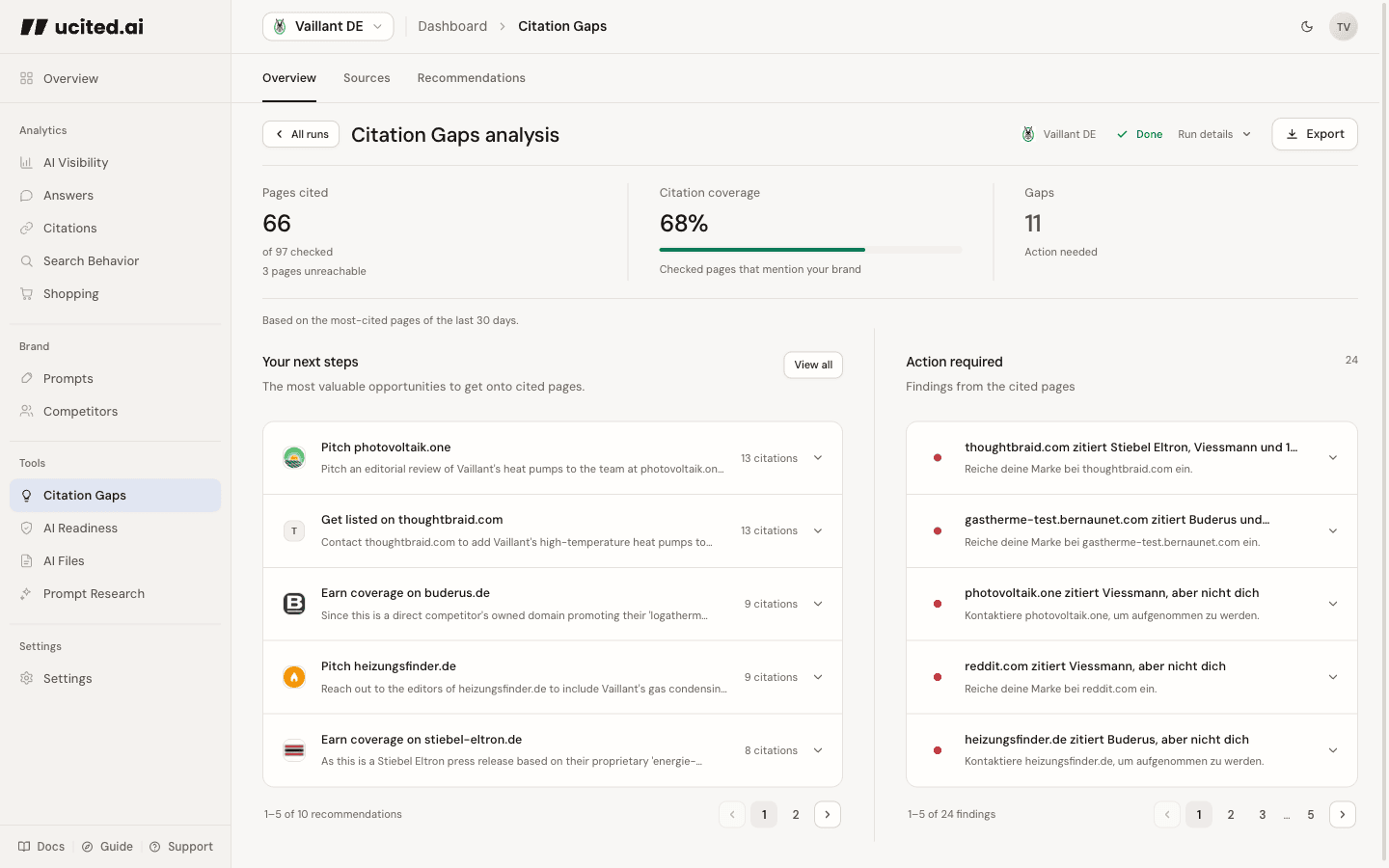
The observed source landscape for this exact question, English version (analysis of ucited citation data, as of September 2026):
| Cited domain | Type of source |
|---|---|
| aol.com | News aggregator |
| developers.google.com | Platform documentation |
| linkedin.com | Social / opinion posts |
| webfx.com | Agency blog |
| williamreviews.com | Review site |
| aimarketers.pro | Industry blog |
| leaderonomics.com | Leadership content |
| mersel.ai | Vendor blog |
| blog.google | Platform blog |
| help.openai.com | Platform documentation |
For the German version of the same question, the picture is similar but more agency-heavy: Google developer documentation leads, followed by corpinsight.org, business.adobe.com and several German SEO agencies (analysis of ucited citation data, as of September 2026).
On ChatGPT, where the citation signal is reliable, only a minority of observed answers for this question pair carry a source citation at all. ucited.ai distinguishes cleanly between a brand mention and an actual source citation, so only that reliable signal is reported.
What this table tells a decision-maker in one sentence: the question is being asked, the engines do cite sources for it, and none of those sources is the brand that should own the answer.
How do I quantify the value of a citation?
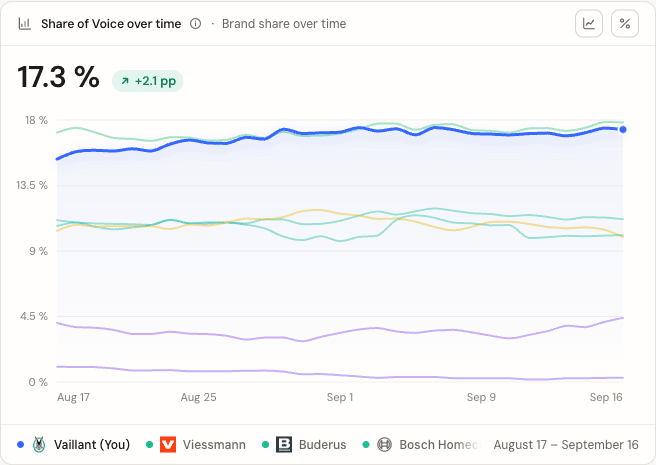
Answer block: Do not try to attach an exact revenue figure to a single citation; you will not be able to defend it. Instead, size the opportunity in three layers: the number of buyer questions in your category that answer engines currently answer, the share of those answers in which your domain is cited (your citation share of voice), and the pipeline value of the pages that would carry those citations. The gap between your citation share of voice and that of the top cited competitor is the number that anchors the budget.
A defensible sizing approach:
- Step 1: Question inventory. Collect the questions buyers ask in each funnel stage. Sources: sales calls, support tickets, existing keyword research, and the "People also ask" style follow-ups the engines themselves generate.
- Step 2: Baseline measurement. For each question, record over several days which domains are cited by each answer engine. Answer engines are non-deterministic, so single checks are noise; you need repeated observations per question and model. This is the job a monitoring tool like ucited.ai automates.
- Step 3: Share of voice. Compute citations for your domain divided by total citations observed per question set. Compare against the top three cited domains.
- Step 4: Attach business context. Map the questions to the pages and product lines they would feed. Use your existing conversion data for those pages, not a hypothetical AI conversion rate.
Avoid quoting industry averages for "AI traffic conversion" unless you can cite the study. A CFO will trust your own baseline more than a vendor benchmark.
What does a low-risk GEO pilot look like?
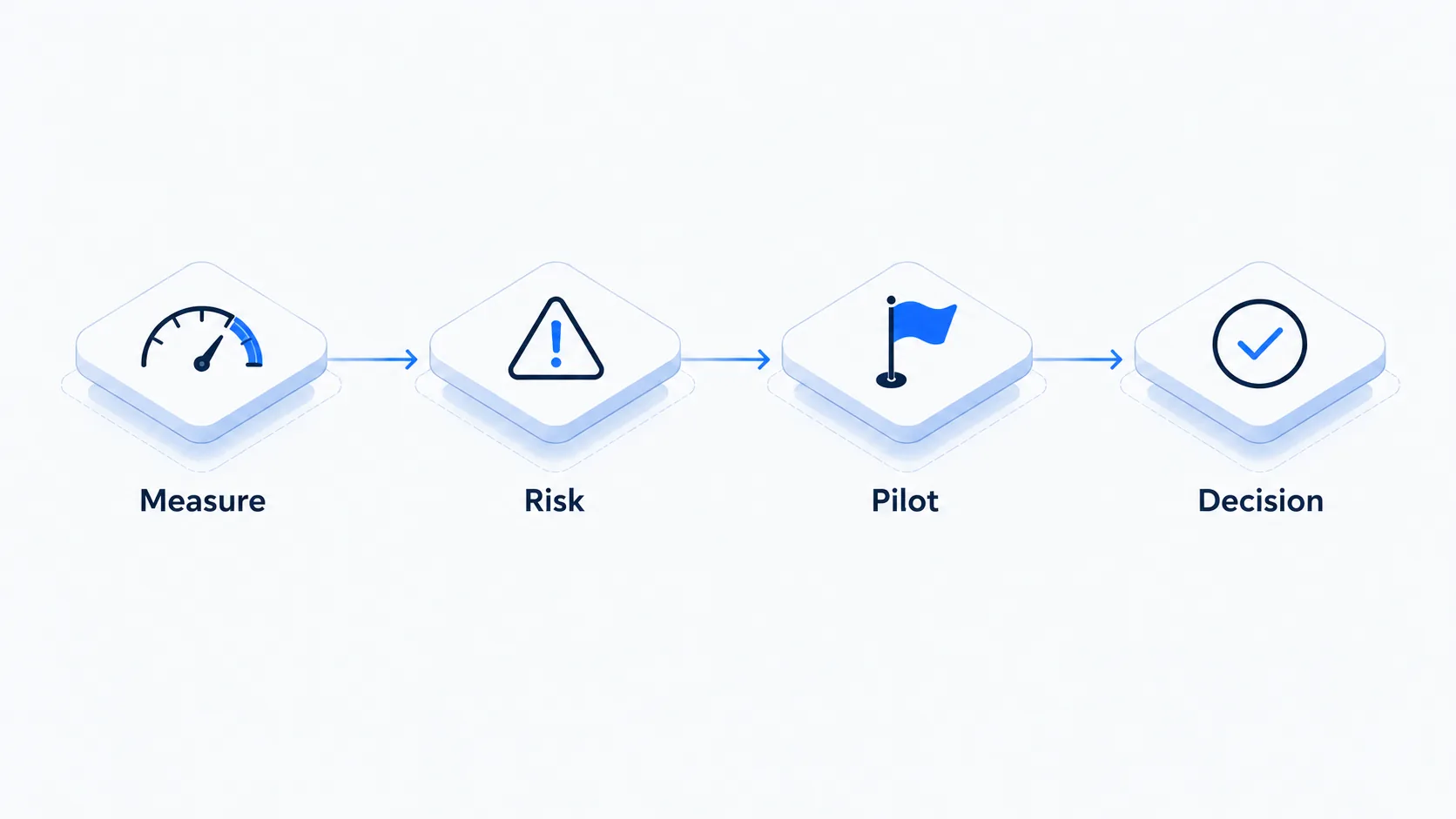
Answer block: A credible pilot is time-boxed to one quarter, limited to one topic cluster of ten to twenty buyer questions, and measured on one primary metric: citation share of voice for your domain across the chosen answer engines. Content work in the pilot focuses on making a small number of pages directly quotable, for example by adding self-contained answer blocks, clear headings and verifiable facts. Success means a measurable increase in citations versus baseline; failure is equally informative and cheap.
Suggested pilot structure:
- Weeks 1–2: Baseline. Set up monitoring for the chosen question set across ChatGPT, Perplexity, Google AI Overviews and Copilot. Record who is cited today.
- Weeks 3–8: Treatment. Rework or create the pages that should answer these questions. Priorities: a two-to-four-sentence direct answer at the top of each section, descriptive H2/H3 headings, facts with sources, an FAQ block where appropriate.
- Weeks 9–12: Measurement. Compare citation share of voice before and after. Report per engine, because behaviour differs between models.
- Decision gate. Scale to further clusters if citation share of voice moved; otherwise, revise the content approach before spending more.
Note on evidence: the specific tactic of self-contained answer blocks is currently classed as experimental, with a literature-based prior expected effect rather than confirmed results from completed experiments (Tian et al. (2026)). Present it to leadership as a hypothesis under test, not a guaranteed lever.
Which objections will leadership raise, and how do I answer them?
Answer block: The most common objections are that AI search traffic is too small to matter, that it cannot be measured, that it is just SEO under a new name, and that the tools are immature. Each has a factual answer: the traffic share is measurable in your own analytics and monitoring data, citation share of voice is a concrete metric, GEO shares foundations with SEO but optimizes for a different outcome, and the monitoring category already exists as a SaaS market.
| Objection | Response |
|---|---|
| "AI search is a tiny share of our traffic." | Referral traffic from answer engines under-reports influence, because many answers are consumed without a click. Measure citations, not only sessions. Start with your own baseline instead of external estimates. |
| "We can't measure it." | Citation monitoring records, per question and per engine, which domains are cited over time. Share of voice and citation frequency are standard outputs of GEO analytics tools such as ucited.ai. |
| "Isn't this just SEO?" | The technical foundation overlaps (crawlability, structure, authority). The optimization target differs: being quoted inside an answer, not ranking on a results page. Rankings reports will not reveal a citation gap. |
| "The market is too early." | That is the argument for a pilot rather than a programme. A one-quarter test with one cluster costs little and produces your own evidence either way. |
| "Our competitors aren't doing it." | Check who is cited for your buying questions. In the example above, the cited sources are publishers, agencies and review sites, which means the category is being defined by third parties, not by any competitor yet. |
What should the internal pitch document contain?
Answer block: A one-page business case for GEO should contain five elements: a one-sentence problem statement, a table showing who is currently cited for your top buyer questions, a baseline share-of-voice number, a quarter-long pilot plan with one primary metric and a budget, and a decision gate. Anything longer dilutes the argument.
Checklist:
- Problem statement: "Answer engines cite X, Y and Z for our buying questions; we are absent."
- Evidence table: ten to twenty questions, cited domains per engine, observation period.
- Baseline metric: our citation share of voice versus top cited domain.
- Pilot scope: one cluster, one quarter, content changes named.
- Budget: tooling (monitoring), content hours, review time.
- Decision gate: what result triggers scaling, what result triggers a stop.
How ucited.ai fits into the business case
ucited.ai is a GEO analytics SaaS tool. Its role in a business case is to supply the evidence layer: it monitors, per question and per answer engine, whether and how often a domain is cited, computes citation share of voice against competing cited domains, analyses the citation and source landscape, and assesses AI readiness of content. It does not produce content or run campaigns; it measures whether content changes translate into citations. In the pilot structure above, it covers the baseline and measurement phases.
Frequently asked questions
How long does it take to see GEO results?
Answer engines re-retrieve sources continuously, so changes can be observed within weeks rather than months, but the exact lag varies by engine and topic. Plan a quarter for a pilot so that repeated observations smooth out day-to-day variance.
Do we need new content, or can we adapt existing pages?
Usually existing pages. Most of the work is structural: adding a direct, self-contained answer at the start of each section, clarifying headings, and adding verifiable facts with sources. New pages are only needed where no page currently addresses a buyer question.
Which answer engines should we monitor first?
Start with the engines your buyers actually use, which typically means ChatGPT, Perplexity, Google AI Overviews and Microsoft Copilot. Be aware that citation behaviour differs between engines, and that not every engine exposes citations in a way that can be validated equally well. Report per engine rather than as a single blended number.
Is GEO a replacement for SEO?
No. GEO builds on SEO fundamentals such as crawlability, structured content and topical authority. It adds a different success metric, the citation, and content patterns that make pages easier for LLMs to quote. Budget for it as an extension of the organic programme, not as a substitute.
What is a realistic first success metric?
Citation share of voice for a defined question set, measured against the baseline and against the top cited competing domains. Traffic and leads are secondary metrics in a pilot because the observation window is short and the attribution path from a citation to a visit is incomplete.