Generative Engine Optimization (GEO) for B2B SaaS means structuring your website so that ChatGPT, Perplexity, Google AI Overviews, Gemini and Copilot can extract, quote and attribute your content when buyers ask them about your category. Unlike classic SEO, the goal is not a ranking position but a citation: your domain appearing as a named source inside an AI answer. This guide explains what is different about SaaS, which sources AI engines currently cite for this exact question, and a six-step playbook built around self-contained answer blocks.
What is GEO for B2B SaaS?
GEO for B2B SaaS is the practice of making a software vendor's website the source that AI assistants cite when prospects ask evaluation questions such as "best tool for X", "how do I solve Y" or "A vs. B". It combines three things: content that answers a buyer question completely in a short, quotable block, a site structure that AI crawlers can access and parse, and continuous monitoring of whether your domain is actually cited. The outcome metric is citation share (Citation Share of Voice in AI answers), not organic traffic.
How GEO differs from SEO for a SaaS vendor
- Unit of success. SEO measures rankings and clicks. GEO measures whether your domain is named as a source in a generated answer.
- Unit of content. Search engines index pages. AI engines extract passages. A page that "ranks" but has no clearly bounded, quotable passage is often skipped in favour of a page that does.
- Query shape. SaaS buyers ask AI assistants long, conversational questions ("How do I optimize a B2B SaaS website specifically for visibility in AI search engines?"). Your content needs to mirror that question shape, not a two-word keyword.
- Competitive set. Your competitors for a citation are not only other vendors but official platform documentation, aggregator lists and agency blogs (see the data below).
Why B2B SaaS is a special case
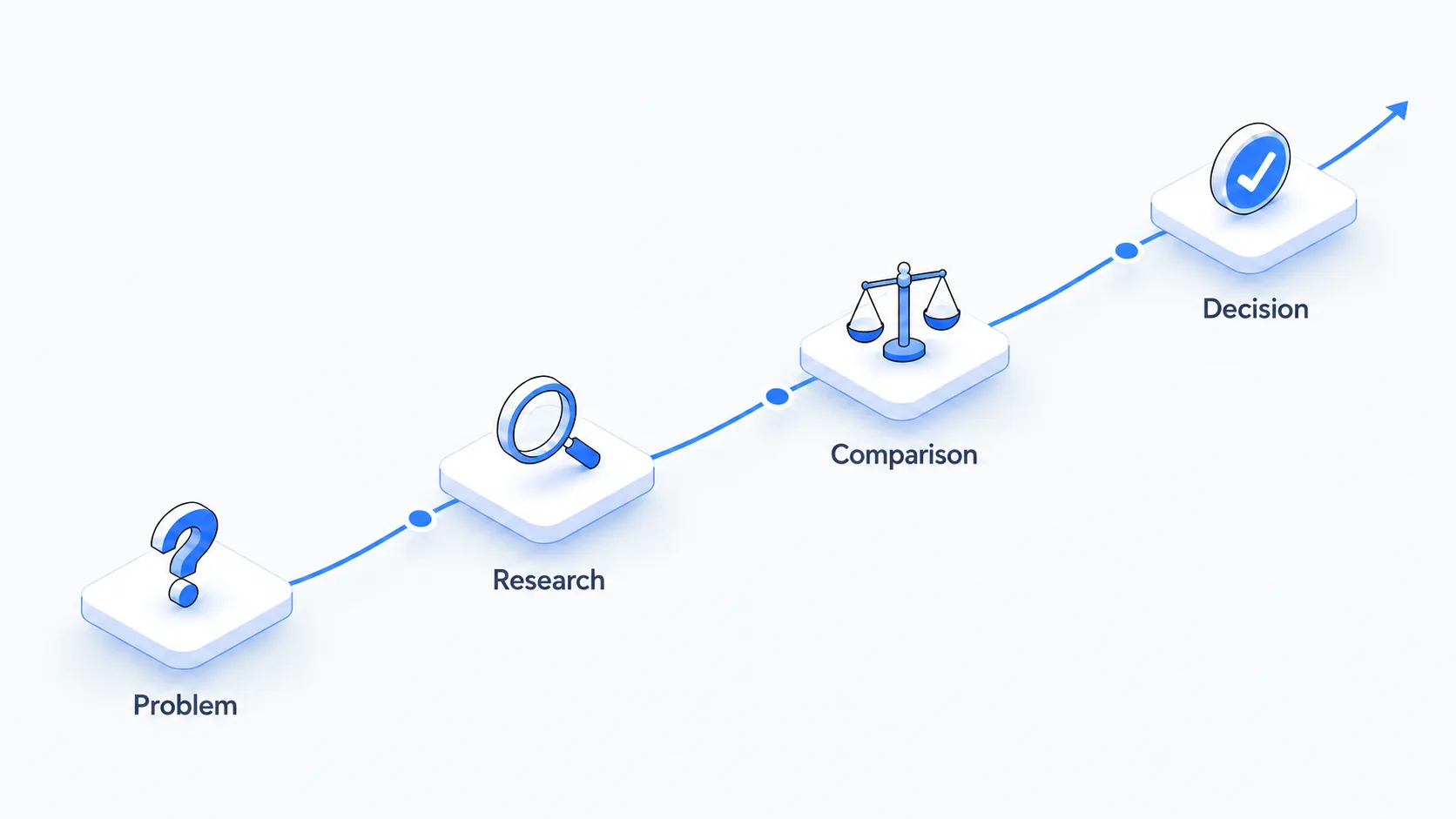
B2B SaaS is a special case for GEO because buying decisions run through comparison and evaluation prompts rather than transactional searches, and because vendors already own large volumes of highly structured, factual content (documentation, help centres, changelogs, integration pages) that AI engines can cite directly. The challenge is rarely a lack of content. It is that the content is written for existing users rather than for the evaluation questions prospects put to an AI assistant.
Typical prompt patterns for a SaaS category:
- Category discovery: "Which SaaS tools exist for [job to be done]?"
- Regional or compliance filters: "Which European (GDPR-compliant) tools exist for [category]?"
- Build vs. buy: "Should we build [capability] in-house or buy a SaaS tool?"
- How-to for the buyer's own site: "How do I optimize a B2B SaaS website for AI search visibility?"
- Head-to-head comparisons: "[Vendor A] vs. [Vendor B]"
Each of these is a candidate for its own page with its own answer block.
What AI engines currently cite for this question
For the question "How do I optimize a B2B SaaS website specifically for visibility in AI search engines?" (asked in German and English), the most-cited domains are official platform documentation and a handful of GEO tool and agency blogs. That is the visibility gap this guide is meant to close.
Most-cited domains across both language variants (analysis of ucited citation data, as of September 2026):
| Domain | Type of source |
|---|---|
| developers.google.com | Official search documentation |
| bing.com | Official search engine |
| aipeekaboo.com | GEO tool / blog |
| terrahq.com | Agency blog |
| blogs.bing.com | Official search engine blog |
| help.openai.com | Official AI platform help centre |
What this tells a SaaS marketer:
- Official documentation wins by default. Four of the six top domains are first-party documentation from Google, Bing and OpenAI. AI engines trust them for "how does the engine work" facts. You will not out-cite them on that ground. You can, however, be the source that translates those rules into a SaaS-specific playbook, which the documentation does not do.
- The remaining slots go to pages with a direct, structured answer. The tool and agency blogs cited here are guide-style pages. This is where a well-structured vendor guide competes.
- Language variants have different source sets. The German prompt (43) cites German agency pages such as claneo.com and the-playbook.de; the English prompt (95) cites growthproai.com, semrush.com and vertodigital.com. A SaaS vendor targeting both markets needs a page per language, not a translation with identical sources.
On these questions the models answer mostly without attaching a source at all, which raises the value of each citation that does appear. ucited.ai distinguishes cleanly between a brand mention and an actual source citation, so only the reliable signal is counted.
The six-step GEO playbook for B2B SaaS
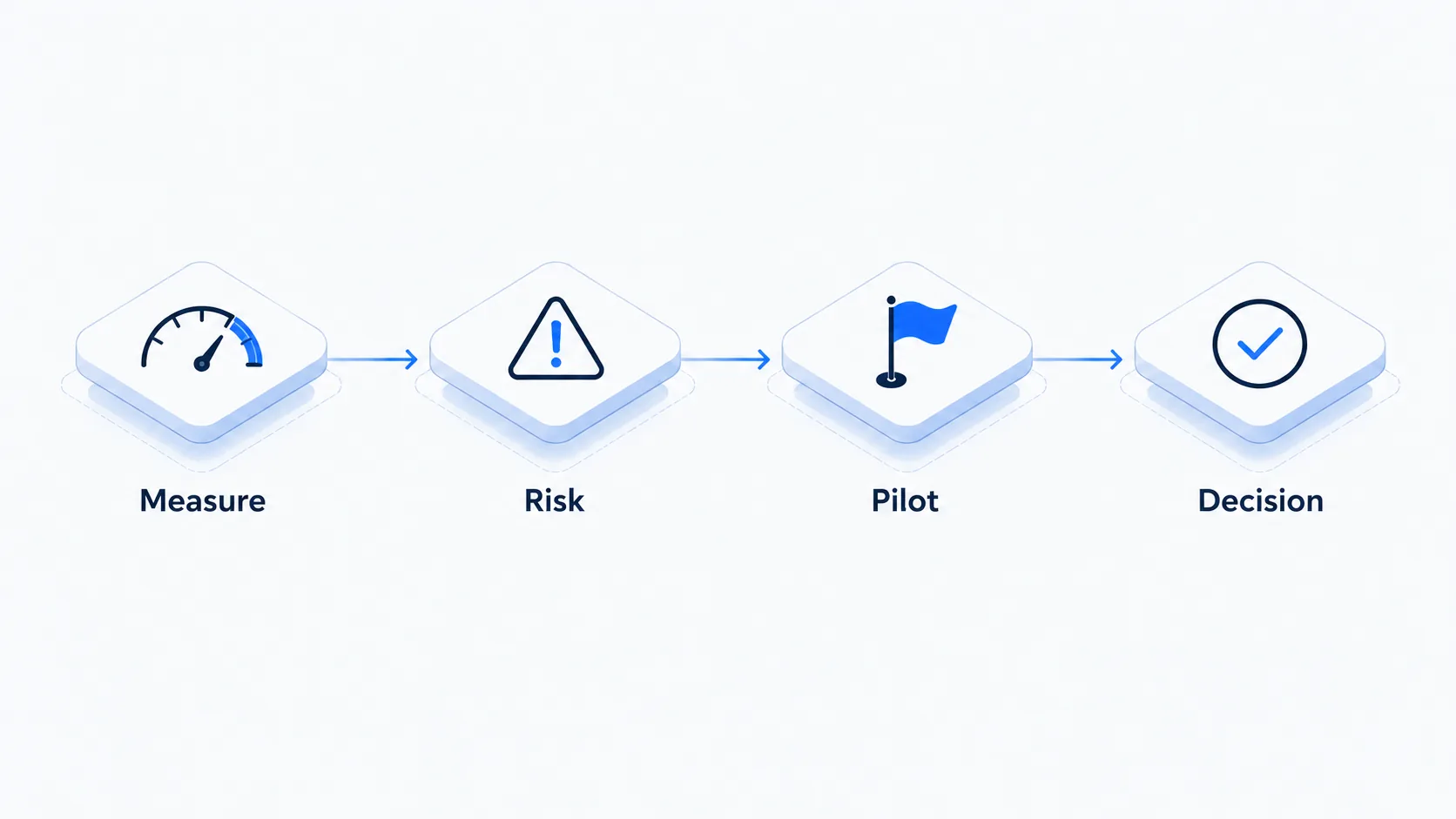
The playbook has six steps: map the evaluation prompts your buyers actually ask, put a self-contained answer block at the top of every page that targets one of those prompts, build comparison and alternatives pages, turn documentation into citable evidence, back claims with verifiable sources, and monitor citations per engine to see what moved. Steps two and five carry the most evidence in the current GEO literature; the others are established practice with weaker experimental support.
Step 1: Map the evaluation prompts, not the keywords
Collect the questions prospects ask AI assistants about your category. Sources: sales call notes, support tickets, community threads, and the prompt sets of a citation monitoring tool. Group them into clusters (discovery, compliance filter, build vs. buy, how-to, comparison). Each cluster becomes a page or a section.
Deliverable: a prompt-to-URL map with one target page per cluster and per language.
Step 2: Add a self-contained answer block to every target page
An answer block is a passage of two to four sentences that fully answers the page's core question without requiring the reader (or the model) to have read anything else on the page. It sits directly under the H1 or the section heading. It names the subject explicitly instead of using pronouns, contains the key qualifier (for SaaS: segment, use case, compliance scope), and does not depend on a table or image to be understood.
Evidence: self-contained answer blocks are among the best experimentally supported GEO measures, treated as a hypothesis under test rather than a confirmed per-page effect (Tian et al. (2026)).
Template for a SaaS feature or use-case page:
[Product] does [job to be done] for [segment] by [mechanism]. It [key capability 1] and [key capability 2], and it is [compliance or hosting qualifier]. It is designed for [role] who need to [outcome], and it is not intended for [explicit non-use case].
Checklist for each block:
- Restates the question's subject in the first sentence.
- Contains no "it", "this" or "here" that points outside the block.
- Contains no claim that needs a footnote elsewhere on the page.
- Reads correctly if pasted alone into a chat window.
Step 3: Build comparison and alternatives pages
Head-to-head and "alternatives to X" prompts are frequent in SaaS evaluation. Create neutral, factual comparison pages that list criteria (data sources, supported engines, hosting region, pricing model, integrations) and state where your product does not fit. A page that concedes weaknesses is more likely to be treated as a reference than a sales page; this is practitioner consensus rather than an experimental result.
Step 4: Turn documentation into citable evidence
Your help centre and API docs already have the properties AI engines favour: one topic per page, precise headings, definitional sentences. Two adjustments make them work for prospects as well as users:
- Add an answer block to each top-level doc page that explains what the feature is and who it is for, not only how to configure it.
- Make sure documentation is crawlable by AI user agents (check robots.txt and any bot-blocking at the CDN). Crawlability is established practice with a weaker evidence base than the content measures.
Step 5: Back every claim with a source or original data
Pages that cite sources and include concrete statistics are among the experimentally supported measures in the GEO literature (Aggarwal et al. (2024)). For a SaaS vendor the strongest form of this is original data: aggregated, anonymised usage patterns or benchmark results from your own platform, published with methodology. If you have no original data yet, cite third-party sources by name and link, and do not fill the gap with rounded estimates.
Step 6: Monitor citations per engine and iterate
GEO changes cannot be validated with rank tracking. You need to know, per prompt and per engine, whether your domain was cited, how often, and which competing domains took the slot. Run this before and after each content change so that a shift in citation share can be attributed to the change and not to model drift. Engine-specific behaviour differs enough that a single aggregated number hides most of the signal.
How to measure GEO progress for a SaaS website
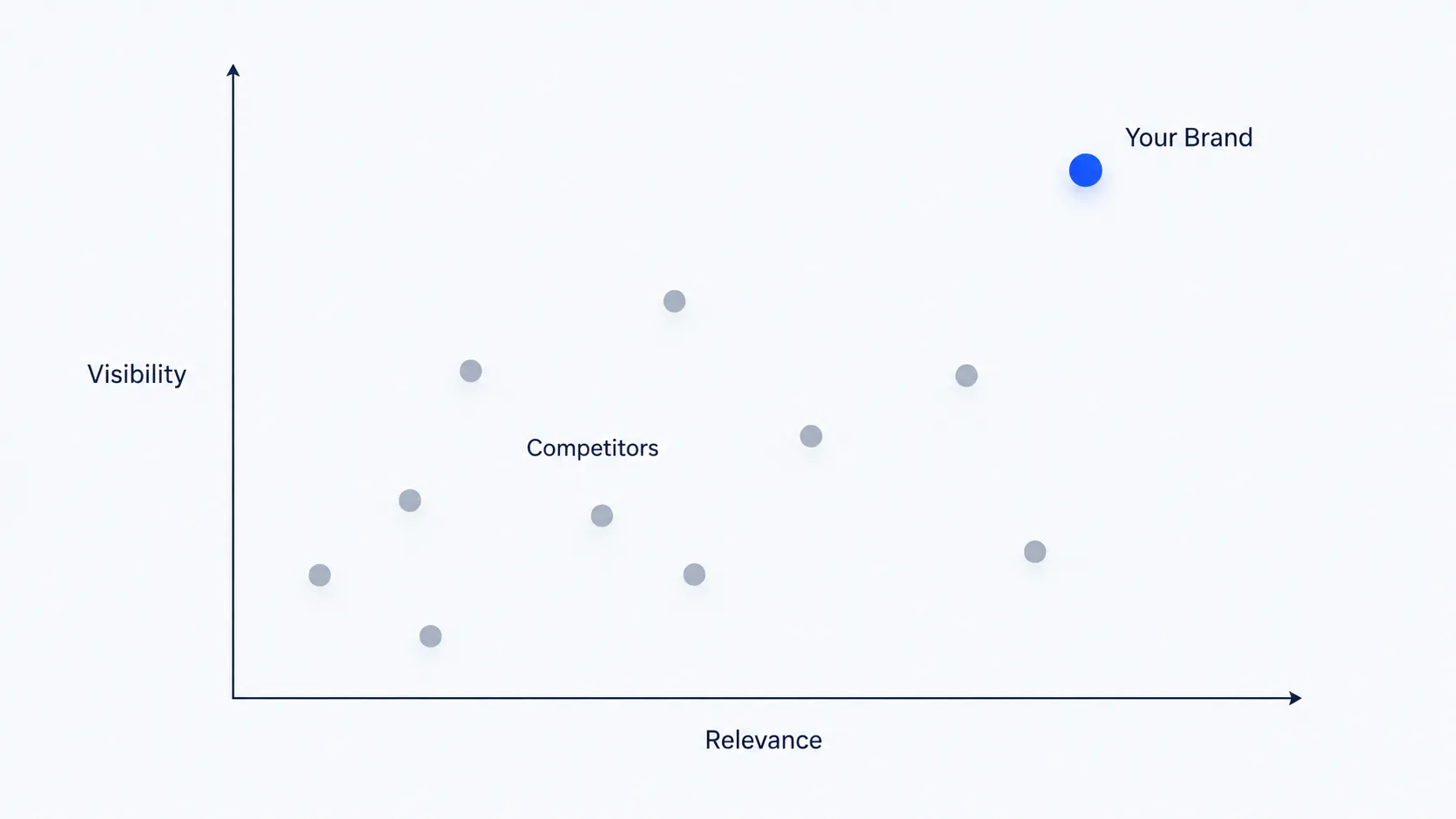
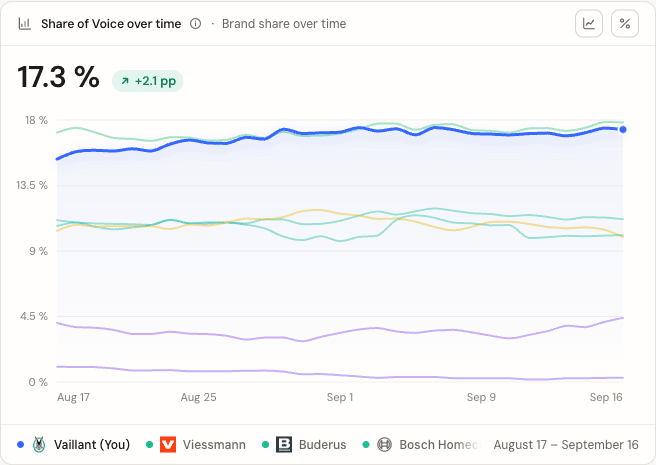
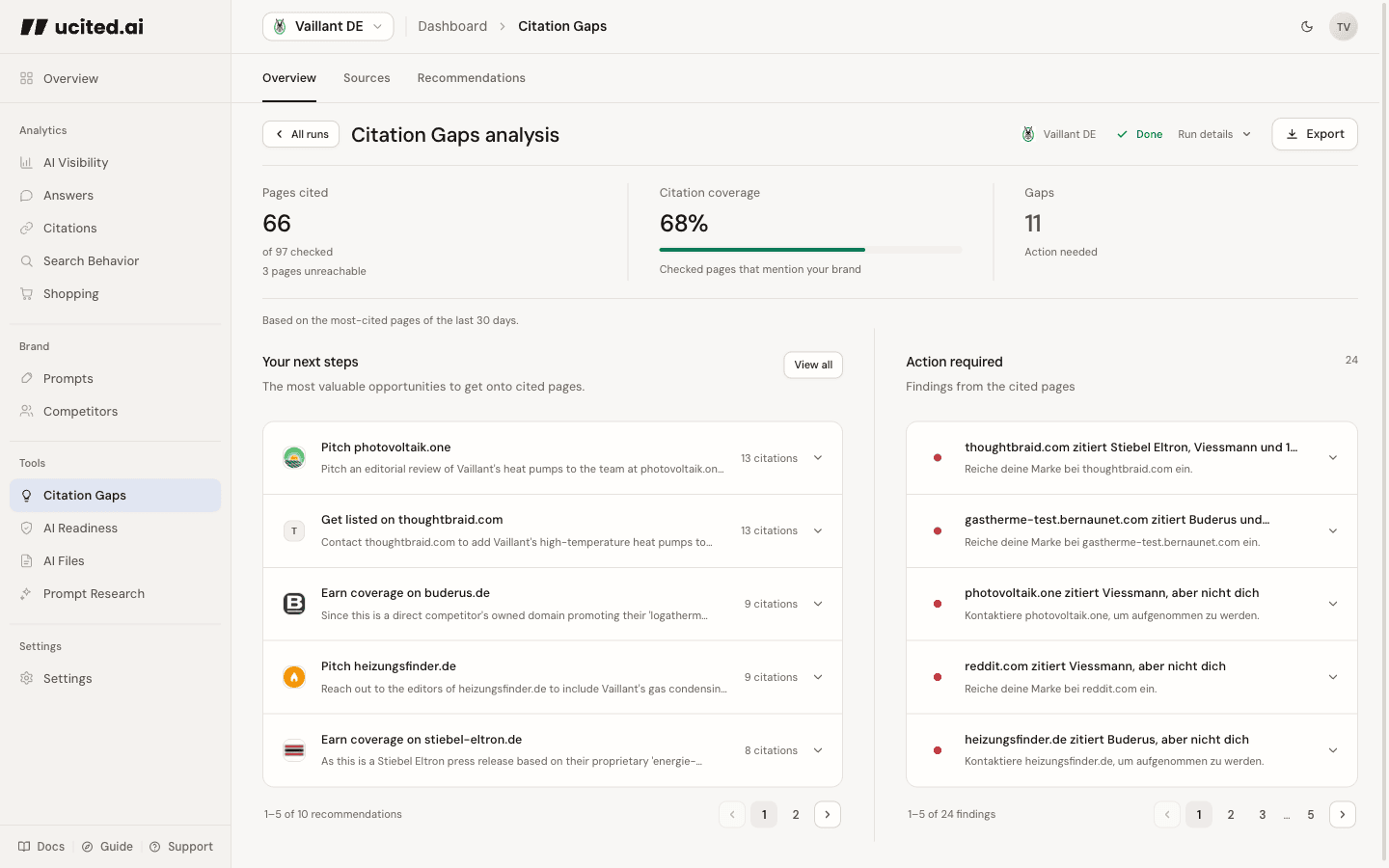
Measuring GEO for a SaaS website means tracking three things over time: whether your domain is cited for a defined set of buyer prompts, what share of all citations for those prompts you hold compared with competitors and platform documentation (Citation Share of Voice), and which of your URLs and passages are being cited. ucited.ai provides these three views as a SaaS monitoring tool: LLM citation monitoring across engines, Citation Share of Voice per prompt cluster, and a citation and source analysis that shows the competing domains, plus an AI-readiness check of your own pages.
Practical measurement setup:
- Define the prompt set from Step 1 in both target languages.
- Record a baseline of citation frequency and top cited domains per prompt and engine.
- Ship answer blocks (Step 2) on the target pages.
- Re-measure after a fixed interval and compare citation share per engine.
- Repeat for comparison pages and documentation.
Frequently asked questions
Does GEO replace SEO for a B2B SaaS company?
No. Holding a strong classic ranking supports AI citations as well, though the evidence for that link is only correlational. GEO adds a second success metric, the citation, on top of rankings and traffic.
Do I need llms.txt or schema.org markup to be cited?
Neither has credible experimental evidence of increasing citations; both carry the weakest evidence of all common GEO measures. Implement them if they are cheap, but do not expect them to move citation share on their own.
How long does it take to see a change in AI citations?
No measured interval is available yet. Plan for repeated measurement rather than a fixed expectation.
Should the answer block be the same on the German and English page?
The content should be equivalent, but the pages should be separate URLs with the language of the target prompt. The data shows different cited source sets for the German and the English variant of the same question, which indicates that engines assemble answers from language-specific pools (analysis of ucited citation data, as of September 2026).
What is a good Citation Share of Voice target for a SaaS vendor?
There is no reliable benchmark figure. Use your own baseline from Step 6 and track the relative change.