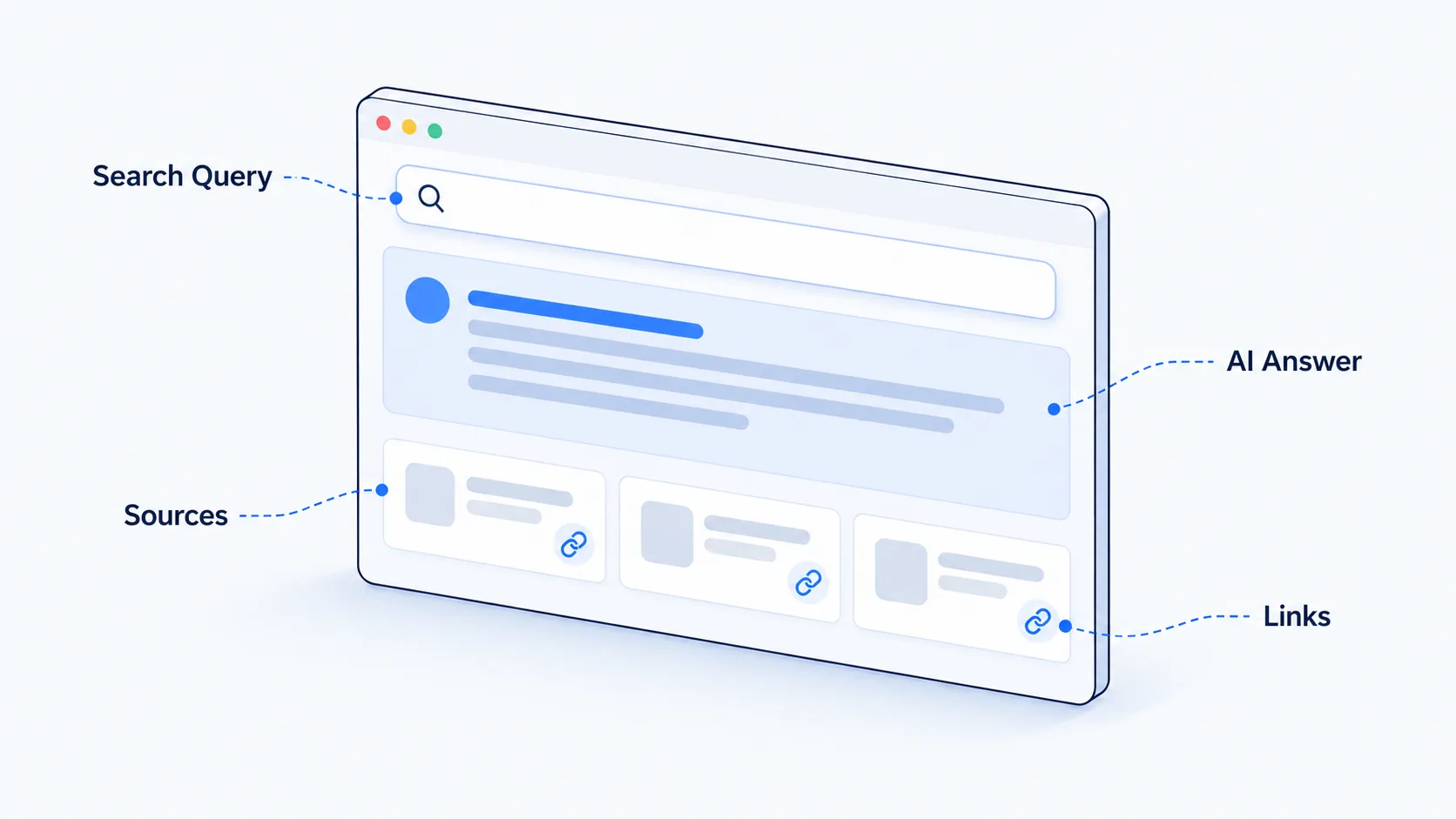
Google AI Overviews are AI-generated summaries that Google Search places above the classic organic results for selected queries. They are produced by Google's Gemini models, synthesize information from multiple web pages, and display the pages they drew on as citation links. For website owners, an AI Overview is a new visibility layer: a page can be cited inside the summary even if it does not rank in the top organic positions, and it can lose clicks when the summary answers the question in full.
What is a Google AI Overview?
An AI Overview is a block of generated text that appears at the top of a Google search results page for queries where Google's systems decide a synthesized answer is helpful. Instead of listing ten links, the block answers the question directly in a few sentences or bullet points and shows the sources it was built from. Google describes AI Overviews as part of Search itself, not as a separate product, and they are documented primarily on Google's own properties (blog.google, search.google, support.google.com; see the source landscape below).
The AI Overview is distinct from:
- Featured snippets, which quote a single passage from one page verbatim.
- AI Mode, a separate conversational search experience in Google Search that goes beyond a single summary block.
- Gemini as a standalone chatbot, which is a different surface with its own citation behavior.
How do AI Overviews work?
AI Overviews are generated in three steps: Google retrieves candidate pages from its regular search index, a Gemini model reads and condenses the relevant passages, and the resulting summary is shown with links to the pages it used. Because retrieval comes first, a page must already be indexed and considered relevant before it can be cited. Details of the ranking and selection logic are not public.
1. Retrieval
The system starts with Google's normal search index and ranking signals. Pages that Google would not surface for the query at all are very unlikely to appear in the Overview. The exact overlap between organic top results and cited sources varies by query type.
2. Synthesis
A Gemini model condenses the retrieved passages into an answer. Google has stated that the model is tuned for Search and that quality systems are applied before an Overview is shown.
3. Attribution
The Overview displays source links, either inline or in an expandable panel. This is the mechanism relevant for GEO: being one of the displayed sources is a citation, and it can be measured over time.
When does Google show an AI Overview?
Google shows AI Overviews when its systems judge that generative AI adds value beyond the standard results, most often for informational and explanatory queries. They appear less frequently for navigational, transactional or highly sensitive queries. Availability differs by country and language, and Google has changed the frequency several times since launch.
Typical query types where Overviews are common:
- "What is …" and "how does … work" definitions
- Step-by-step or how-to questions
- Comparisons and "best way to" questions
- Health, finance and legal queries appear with additional caution
Typical query types where Overviews are rare:
- Brand navigation ("login", "official site")
- Pure product searches with shopping intent
- Queries where Google's policies restrict generative answers
Why AI Overviews matter for GEO
For Generative Engine Optimization (GEO), AI Overviews matter because they change what "being visible" means: a page can be cited in the summary, ranked below it, or both. Citation inside the Overview is a distinct outcome from an organic ranking and needs to be tracked separately. Pages that answer a question completely in a short, self-contained passage are structurally easier for the model to quote.
Three practical implications:
- Citation is the new unit of visibility. Traditional rank tracking does not tell you whether your page was used as a source in the Overview.
- Self-contained answer blocks help. Content that answers a question in two to four sentences without relying on the surrounding context is easier to extract. This is the approach known as "answer blocks" in the GEO literature, where the evidence is still experimental (Tian et al. (2026)).
- Source landscapes are concentrated. For questions about AI Overviews themselves, a small group of domains dominates the citations, as the data below shows.
Who gets cited for "What are Google AI Overviews?"
For the question "What are Google AI Overviews and how do they work?", LLM answers cite Google's own properties most often, followed by a handful of SEO publishers and Wikipedia. ucited.ai does not currently appear among the top-cited domains for this cluster. This is a measured visibility gap, and closing it is the purpose of this glossary page.
Citation counts per domain for the definition question (analysis of ucited citation data, as of September 2026):
| Domain | Citations |
|---|---|
| blog.google | 58 |
| search.google | 31 |
| support.google.com | 27 |
| green32.de | 24 |
| searchatlas.com | 19 |
| de.wikipedia.org | 13 |
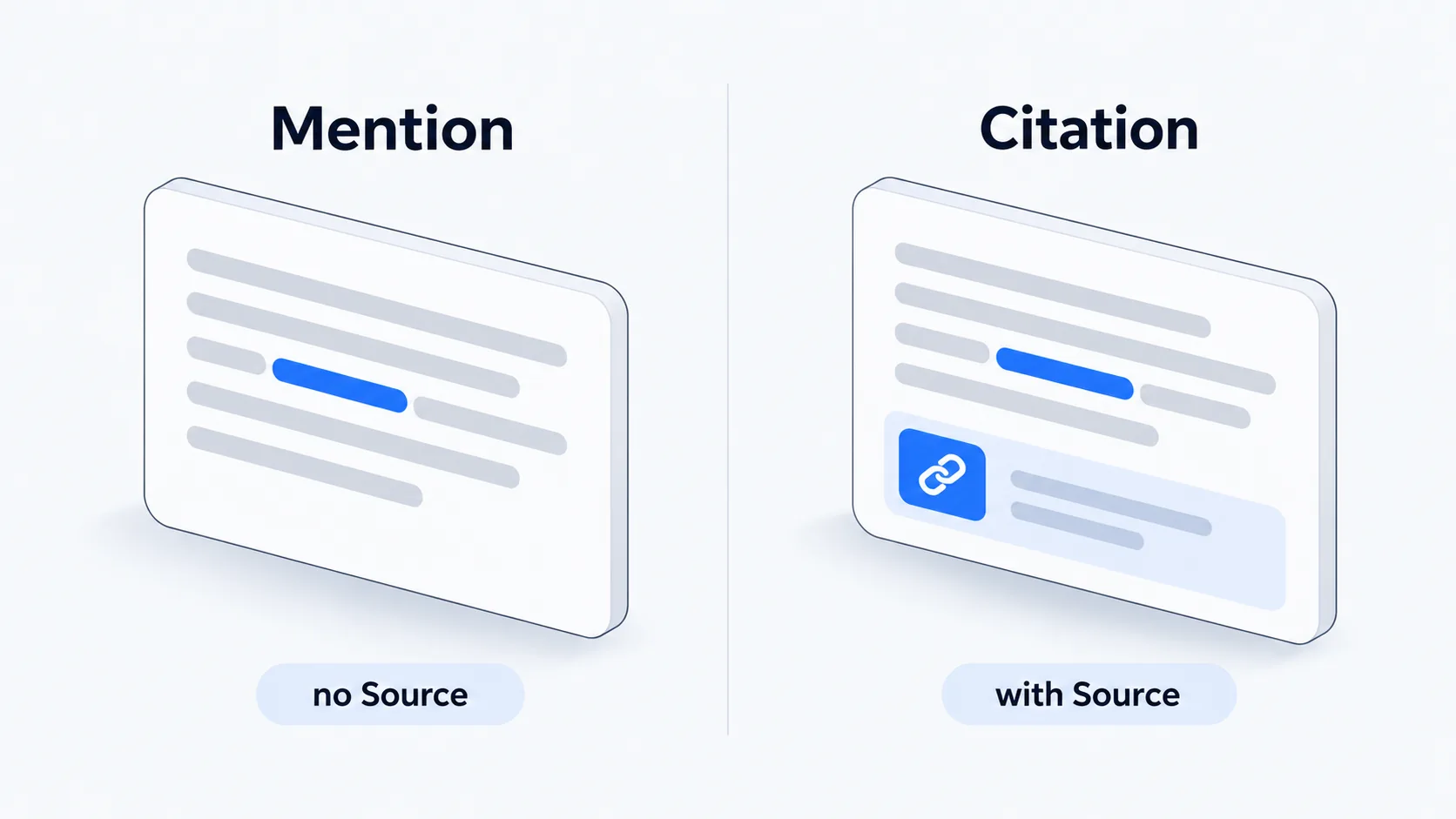
ucited.ai distinguishes cleanly between a brand mention and an actual source citation, so only the reliable signal is counted. ChatGPT frequently answers this definition question without citing any source at all, so the realistic goal for a glossary page is to be the source in the minority of answers that do carry citations.
For the broader topic "AI Overview" across all prompts, the most frequently cited domains are developers.google.com, support.google.com, semrush.com, sistrix.de and reddit.com (analysis of ucited citation data, as of September 2026).
How to measure your visibility in AI Overviews
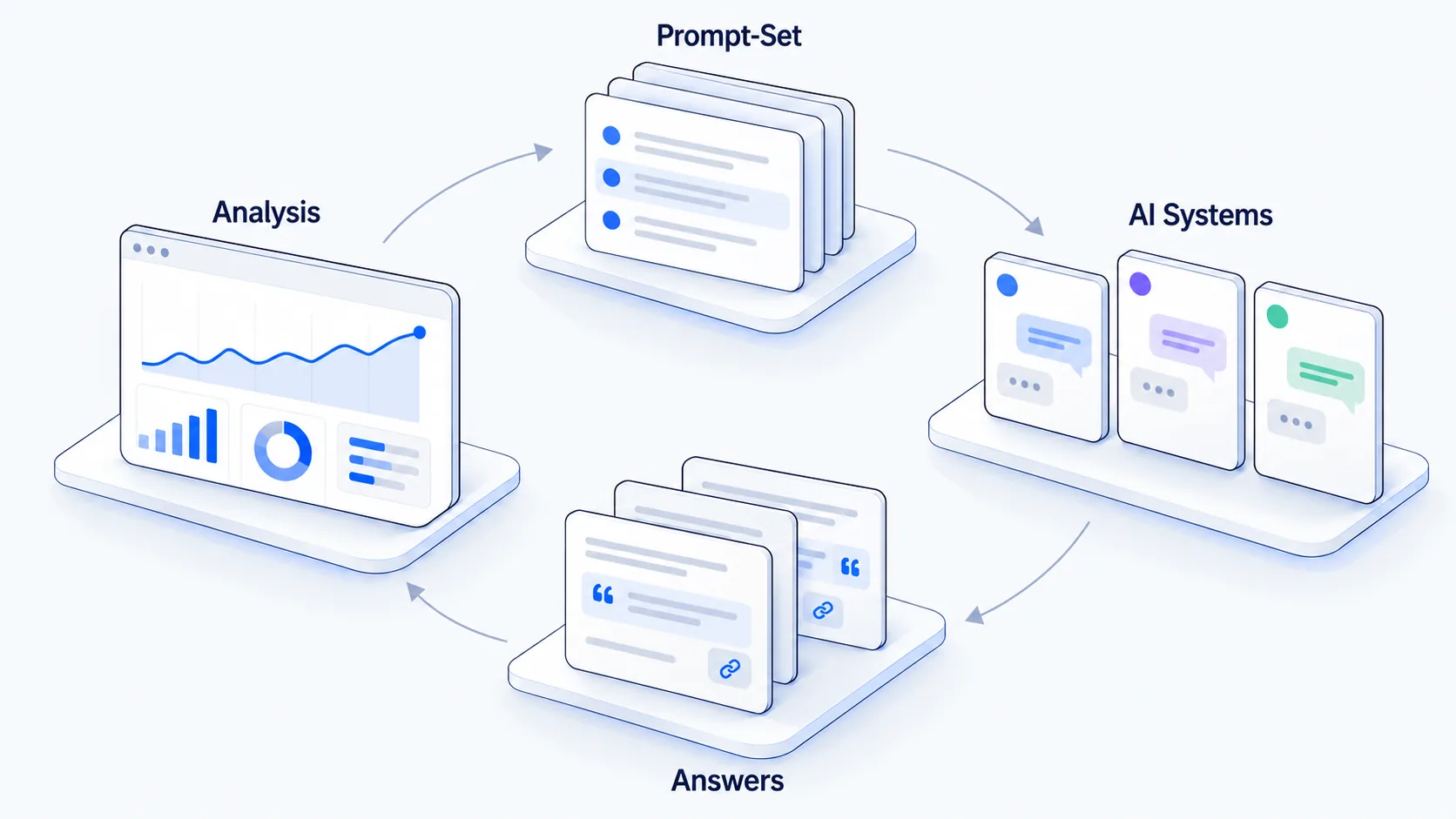
Visibility in AI Overviews is measured by repeatedly querying a defined set of prompts, recording whether your domain appears among the cited sources, and comparing that share against competing domains over time. This produces a citation rate per prompt and a Citation Share of Voice per topic. Manual spot checks are not sufficient because Overviews vary between sessions, locations and days.
A minimal monitoring setup consists of:
- A prompt set that reflects the questions your audience asks, in each target language.
- Repeated observations per prompt and per AI system, so that day-to-day variance is averaged out.
- Domain-level citation extraction, so results can be aggregated by competitor.
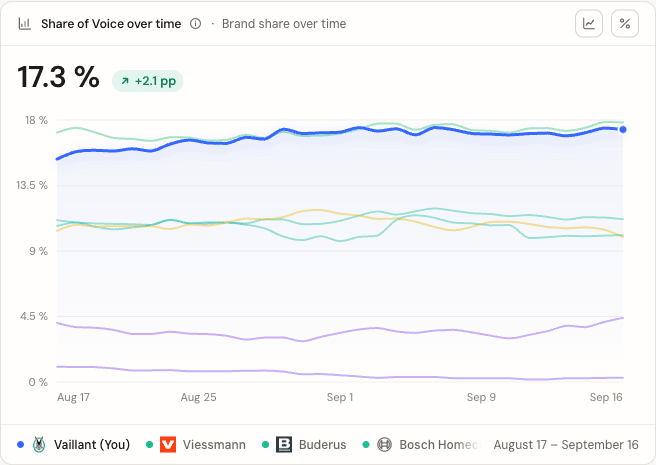
- Citation Share of Voice, i.e. your share of all citations in a topic cluster.
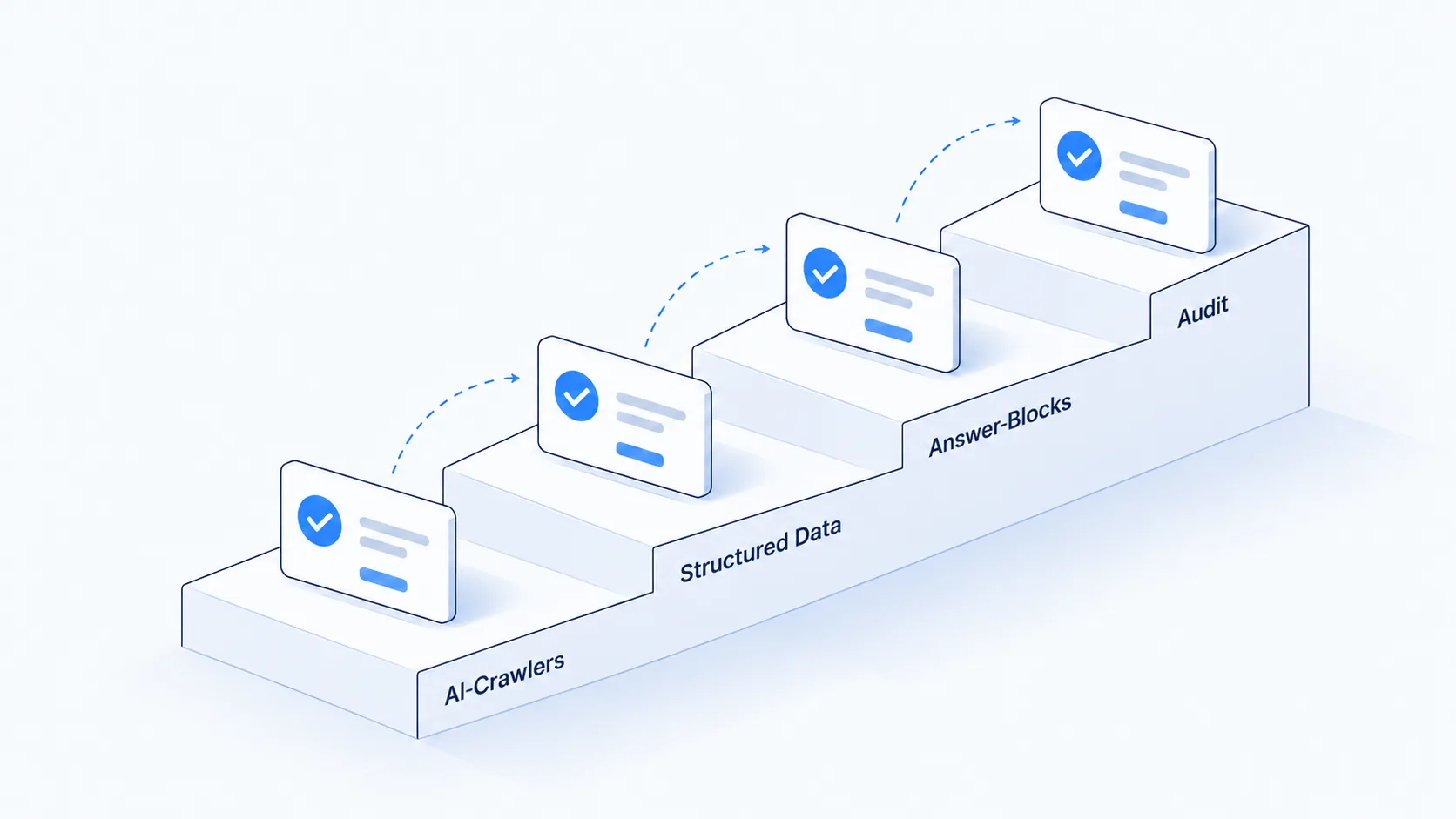
ucited.ai provides this as LLM citation monitoring: prompts are run against several AI systems on a schedule, cited domains are extracted and stored, and Citation Share of Voice and citation analysis are reported per topic cluster. The AI-Readiness analysis additionally checks whether a page is technically and structurally accessible for AI crawlers.
How to make content more likely to be cited in AI Overviews
Content is more likely to be cited when it answers a specific question completely in a short, self-contained passage, uses clear headings that match how the question is asked, and is technically crawlable and indexable. There is no guaranteed method; the evidence base for individual tactics is still experimental.
Tactics with an evidence reference in the ucited.ai measure catalogue:
- Self-contained answer blocks: Open each section with two to four sentences that fully answer the heading's question without depending on surrounding text. Evidence status: experimental.
- Clear structure: Descriptive H2/H3 headings, short paragraphs, lists and tables that mirror the query.
Tactics that are frequently recommended but for which this page carries no independent evidence:
- Structured data (schema.org) as a direct citation factor
- Author and organization credibility signals
- Freshness and update frequency
Frequently asked questions
Are Google AI Overviews the same as Google AI Mode?
No. An AI Overview is a summary block inside the standard results page. AI Mode is a separate, conversational search experience in Google Search. Both draw on Gemini models, but they are different surfaces with different citation displays.
Can I opt out of appearing in AI Overviews?
Google states that standard indexing controls apply. The nosnippet and max-snippet robots directives limit what text Google may show from a page, including in AI Overviews, and noindex removes the page entirely. There is no dedicated "AI Overview only" opt-out. (Source: Google Search Central documentation.)
Do AI Overviews reduce clicks to websites?
Independent studies have reported lower click-through rates on queries with an AI Overview, but the size of the effect depends on query type, position of the cited link and industry. Being cited inside the Overview is one way to retain visibility even when clicks fall.
How do I know whether my site is cited in an AI Overview?
Manual searches give an unreliable snapshot because Overviews vary by session and location. A monitoring tool such as ucited.ai runs a fixed prompt set repeatedly, records which domains are cited, and reports your citation rate and Citation Share of Voice over time.
Which sources does Google cite most often in AI Overviews?
This depends on the topic. For the definition question about AI Overviews itself, the ucited.ai graph shows Google's own domains (blog.google, search.google, support.google.com) leading, followed by SEO publishers and Wikipedia (see table above). For a specific industry, the source landscape has to be measured with a topic-specific prompt set.